


The cluster of circles displayed on the screen looks as though a child had blown a pile of particularly soapy bubbles out of a straw and onto clear glass. It's quiet. There is only the machine's steady hum. At the desk next to the screen, a young woman sits perfectly still, her brow pressed against the lens of a microscope. Where I see nothing but playful shapes, she sees an impending decision, her decision. Hers and ERICA's.
ERICA does not feel back pain or fatigue. It doesn't need a morning coffee or have bad days. ERICA is an artificial intelligence (AI) tool designed to help the woman at the microscope assess the embryos represented by those circles. Its name is an acronym for the foundational algorithm on which it was initially based – the Embryo Ranking Intelligent Classification Algorithm.
Every day, embryologists are 'making judgments on which embryos should be selected and transferred,' Dr Molly Johnston, a bioethicist and Research Fellow at Monash University, Melbourne, Australia, explains to me. 'In a way, we are making life-or-death decisions.' The woman at the microscope makes such decisions not once, but a dozen times a day.
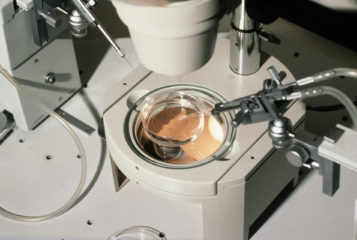
Morphological assessment involves looking at an embryo at different stages of development and evaluating its quality based on visual features such as the number and symmetry of cells. It requires both precision and speed. Embryos have a narrow window of time in which they can be safely handled. Embryologists can spend hours a week sitting in front of a microscope, looking at developing cells. Because assisted reproductive technology procedures today are still heavily reliant on the embryologist's focus and dexterity, a bad day for an embryologist could mean a patient misses another chance to build a family. This is where AI tools like ERICA take the stage.
The idea behind AI tools focused on embryo selection is simple: you feed an algorithm images of developing embryos alongside their associated outcomes. Over time, the system learns to identify visual features that may be associated with viable pregnancies. Most products available today are decision-support tools, not designed to replacing embryologists but intended to aid their judgments or give a second opinion.
Professor Andrew Drakeley, gynaecologist and co-founder of IVF 2.0 (the company that develops ERICA), explains to me: 'It might change the role that they [embryologists] do. Just as 30 years ago we used to use paper roadmaps and now we use a sat nav. It gives us prompts and helps to make us more efficient so we're not taking our eyes off the road.'
AI tools can help share embryologists' workload and reduce time spent on repetitive tasks. 'You may not need as many highly trained embryologists per IVF lab to run it efficiently,' Professor Drakeley tells me.
This is good news for regions where embryologists are hard to come by and access to fertility services is sparse. 'In large areas – Saudi Arabia, USA, even China – the provision of fertility services in terms of IVF is really quite under-resourced,' Professor Drakeley says, 'to have some of the decisions assisted or made more efficient may well be an advantage.'
While our embryologist sits at her microscope in the lab, consulting tools like ERICA to evaluate cells in a petri dish, her patient at home anxiously awaits her call. This is unlikely to be the patient's first attempt at IVF. Although some patients eventually succeed, each failed attempt makes the emotional exhaustion weigh heavier. The relationship with their embryologist is essential.
'What came out of our qualitative work with patients and providers was this concern around the integration of AI coming at the loss of the humanness in fertility treatment,' Dr Johnston says. 'Patients really spoke about valuing the kind of connections that they made with the clinical staff [...] and emphasised this need for compassion and empathy.'
When our embryologist calls her patient on day five of their IVF cycle, she will share how many embryos have developed and whether any may be suitable for transfer. For the patient, it is nerve-racking, possibly life-changing, and if none has made it, it is often devastating. It is natural for them to ask, 'Why didn't the embryos make it?' and 'Who decides that they haven't?'. But what happens when these decisions are outsourced to AI tools that cannot offer compassion, or perhaps even an explanation?
Machine learning can identify patterns in data that are difficult for humans to interpret, assessing which features are predictive of success even when the people overseeing the technology cannot fully understand how the conclusions are reached. Research into AI in medicine highlights the challenges of understanding how some models arrive at their predictions. '[...] a lot of these systems are referred to as black boxes,' Dr Johnston explains to me. 'Once [the AI] assesses an embryo, it will spit out a score, and that could be out of ten. But that's really all the information you get.'
Bioethicists such as Dr Johnston are asking who is accountable for decisions made in collaboration with an AI whose reasoning may be unknowable. If a recommendation is wrong, who is responsible for explaining it to the patient?
AI tools aren't neutral entities. Many are trained on retrospective data from clinics, with often homogeneous patient populations. With data from the Human Fertilisation and Embryology Authority (HFEA) showing lower average IVF birth rates among Black and Asian patients than among white patients, some wonder whether AI is doomed to perpetuate existing biases. After all, if our embryologist cannot be certain of how her AI assistant arrived at its recommendation, how can her patient be sure that the data the AI compares them with is representative of people like them? If IVF clinics are to retain their patients' trust, some experts argue, AI tools should be validated in the populations and clinical settings in which they will be used. But who ensures that they are?
I keep returning to that quiet morning in the lab. The machine will hum, a cluster of bubbles will fill the screen, a score will appear, and our embryologist will make a call. AI could help make that morning faster, cheaper and more accessible. That is worth having, and when the procedure succeeds, it may well be what patients value most. But when it fails, they will have questions that deserve an explanation as well as compassion. The real test is not whether AI can grade an embryo, but whether it can leave the essential humanness of that moment intact.
The article above by Katharina Stock won first prize in the Marcus Pembrey BioNews Writing Competition 2026. The competition is named in honour of Professor Marcus Pembrey (Patron of PET), and is generously supported by the London Women's Clinic.
Dr Jacques Cohen – Chief Embryology Director at IVF 2.0 and coauthor of the paper that introduced ERICA – will be a keynote speaker at this year's PET Annual Conference, AI and Automation in Fertility and Genomics: Pipeline? Or Pipe Dream?, taking place in central London on Wednesday 9 December 2026. Find out more and register here.
Related Articles


'Choosing not to look is not the same as not caring' – public attitudes to embryo selection
People's opinions on using preimplantation genetic testing for non-medical traits do not always reflect the decisions they make about selecting embryos when presented with the results...

Polygenic embryo screening: The tension between choice and acceptance
Dr Dorit Barlevy looks at the various ethical considerations for prospective parents and clinicians considering using PGT-P...

AI system for embryo selection tested on IVF patients
An artificial intelligence system selected the same embryos as an embryologist 69 percent of the time, with no significant difference in clinical pregnancy rate...
Guidelines breached by half of UK fertility clinics selling time lapse imaging
Huge disparities have been found in how clearly and accurately private UK fertility clinics market time-lapse imaging for embryo selection, raising concerns that there is a lack of clarity for patients...
No evidence for using polygenic risk scores in embryo selection
The use of polygenic risk scores to select embryos is being advertised and sold by some private fertility clinics...
Deep learning tool saves time selecting embryos for IVF
Time spent by embryologists selecting embryos for IVF could be reduced by using artificial intelligence to fuse time-lapse images taken of the developing cells...