

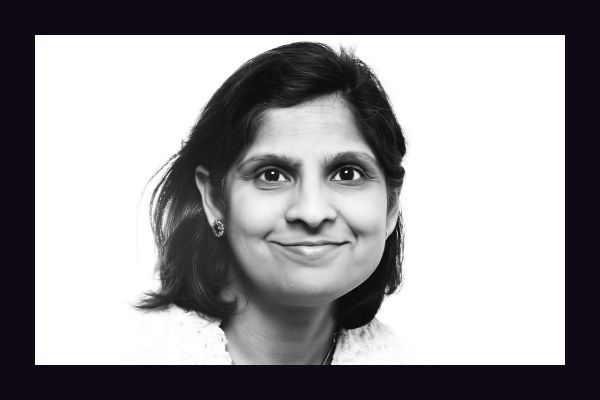
Professor Abha Maheshwari, clinical director and lead consultant at the Aberdeen Fertility Centre, has died aged 55. To the team here at PET (the Progress Educational Trust), the charity that publishes BioNews, Abha was a legend and will be very much missed.
Abha was a generous friend of PET, in more than one sense. In addition to being a member of our Friends of PET scheme and giving us regular donations for many years, she was also unhesitatingly generous with her time and expertise. We could always approach Abha for advice – on medical issues, research issues and policy issues – and be confident that what she told us was insightful and trustworthy.
She spoke at many PET events and helped us to organise many more, advising us on topics and speakers even when not speaking at events herself. Indeed, she very much believed in giving other people speaking opportunities, recommending speakers and giving them support and encouragement when they were less experienced.
Her capacity for hard work never dwindled. She fulfilled many professional responsibilities in addition to her full-time day job, including serving as clinical lead for reproductive health and childbirth at National Research Scotland, and as editor-in-chief of the journal Human Fertility (where we were proud to be guest advisers on an article collection published earlier this year).
Abha was also a keen researcher. In 2012, she and her colleagues published a systematic review and meta-analysis which raised the question of whether it might be advisable for fertility patients to electively freeze all of their embryos (see BioNews 672). She proceeded to answer this question by leading a multi-centre randomised controlled trial called 'E-Freeze', designing the trial and writing the substantial report that resulted from it. She also continued to work on related research, such as this study, which used E-Freeze data to investigate anxiety in couples undergoing IVF.
Our friend Abha will live on in many different ways – not just in the memories of her colleagues and collaborators but also in the joy she brought to so many patients, helping them fulfil their dreams of having a family. What greater legacy could there be?
A fuller obituary of Abha will be published in BioNews in coming weeks. For now, we should like to point you to some of the many presentations she gave at PET events in recent years. The diversity of topics covered below – beginning with a 2019 event that celebrated the history of IVF, and concluding with a 2025 event conceived by Abha which explored the lessons to be learned from the UK's infected blood scandal – speaks to the enormous range of her expertise, experience and curiosity.
40 Years of IVF: Past, Present and Future (2019)
This event celebrated the 40th birthday of the world's second ever IVF baby (and first IVF boy), Alastair MacDonald, and featured Alastair himself and his mother Grace among the speakers. In her presentation – go here to jump straight to that part of the video – Abha says that 'IVF today is slightly different from what it was', explaining how IVF has evolved since its earliest days as an experimental treatment.
IVF Success: What Makes Scotland Special? (2020)
This event explored the successes and experiences of Scottish fertility clinics. In her presentation – go here to jump straight to that part of the video – Abha expresses her love of Scotland, saying 'I'm not from Scotland, but I came here and stayed here'.
She goes on to discuss the origins of the Fertility Scotland network, explaining that the Aberdeen Fertility Centre and other NHS fertility clinics in Scotland 'all try to work collaboratively, rather than in competition'.
Prioritising Patient Safety: How to Minimise Risk in Fertility Treatment (2022)
This event explored the risks posed by IVF, and how best to minimise them. In her presentation – go here to jump straight to that part of the video – Abha builds upon research into this subject that she and her colleagues conducted a decade previously. She argues that 'we have to individualise each patient, and we have to do a risk assessment very early on'.
Till Death Do Us Part: Embryos and Gametes after Death, Divorce or Separation (2022)
This event explored what happens to a patient's stored gametes or embryos, if the patient separates from their partner or if they die. In her presentation – go here to jump straight to that part of the video – Abha explores the complexities that arise from patient consent forms, and considers 'the best use of resources in a publicly funded healthcare system' given these complexities.
Testament to Abha's commitment and professionalism is the fact that during this event's second half – beginning here – she responds to audience questions from an airport waiting room. (She was between flights at the time, but insisted on being available to take questions.)
Understanding Miscarriage: Pregnancy Loss after Fertility Treatment (2023)
This event explored pregnancy loss in the context of fertility treatment. In her presentation – go here to jump straight to that part of the video – Abha says the topic 'is very close to my heart', and goes on to lament the fact that (outdated) UK fertility legislation mandates separate handling of fertility treatment notes and a patient's other medical notes.
Abha says we need a 'much more joined-up approach, because who we are treating is a patient in front of us who is having these difficulties, rather than just treating infertility or just treating miscarriage'. (This discussion is also available as a podcast.)
Welfare of the Fertility Patient: Spotting Signs and Treatment after Trauma (2024)
This event explored how best to understand and address welfare issues in the context of fertility treatment. In her presentation – go here to jump straight to that part of the video – Abha says that 'fertility treatments are an emotional rollercoaster'.
Abha proceeds to give perhaps the frankest and most vivid example imaginable of the importance of this topic, discussing her experience of a fertility patient who seemed outwardly well and whose treatment had been successful, and yet who died by suicide. Abha says such cases 'are luckily rare, but we need to learn the lessons'. (This discussion is also available as a podcast.)
What Can the Fertility Sector Learn from the Infected Blood Scandal and Inquiry? (2025)
This event, conceived by Abha (who proposed the event to PET), explored lessons for the fertility sector from the UK's infected blood scandal and from the subsequent Infected Blood Inquiry. In her presentation – go here to jump straight to that part of the video – Abha draws a parallel between the fertility sector and the handling of blood, saying that both involve 'substances of human origin' and both are 'covered by very heavy legislation'.
Of the infected blood scandal, Abha says: 'The reason all the infections happened is because we were short of blood, we imported it from elsewhere. But we are doing exactly the same in fertility – we are short of donor gametes, we are importing donor gametes.' She suggests that when donor gametes are imported from overseas, it becomes all the more important to be rigorous about safety and donor family limits.
Abha made this argument several months before it became widely known that sperm from a donor with a cancer-causing mutation had been used to conceive at least 197 children in at least 14 countries (see BioNews 1319). This illustrates her prescience, and also illustrates that her great kindness and optimism did not deter her from confronting sobering issues. (This discussion is also available as a podcast.)
Related Articles
Obituary: Professor Abha Maheshwari
A personal tribute to Professor Abha Maheshwari, from her friend and colleague Alison McTavish...

FILM: What Can the Fertility Sector Learn from the Infected Blood Scandal and Inquiry?
This film documents a PET event about lessons for the fertility sector from the UK's infected blood scandal, and from the subsequent Infected Blood Inquiry...
FILM: Welfare of the Fertility Patient – Spotting Signs and Treatment after Trauma
This film documents a PET event about how best to understand and address welfare issues in the context of fertility treatment...
PET Podcast: What Can the Fertility Sector Learn from the Infected Blood Scandal and Inquiry?
Bringing you PET events as a podcast. In the 26th episode of its podcast, PET discusses lessons for the fertility sector from the UK's infected blood scandal, with Professor Abha Maheshwari, Professor Marc Turner, Professor Emma Cave and Professor Bobbie Farsides...

What Can the Fertility Sector Learn from the Infected Blood Scandal and Inquiry?
The latest PET event focused on lessons from the UK's infected blood scandal, and the recently published final report of the Infected Blood Inquiry...
PET Podcast: Welfare of the Fertility Patient – Spotting Signs and Treatment after Trauma
Bringing you PET events as a podcast. In the 16th episode of its podcast, PET looks at how best to understand and address welfare issues in the context of fertility treatment, with Professor Abha Maheshwari, Nicole McKeith, Dr Susheel Vani and Ruth Phillips...

Welfare of the Fertility Patient: Spotting Signs and Treatment after Trauma
This PET event looked at the ways that trauma can affect a patient's experience of treatment, and explored the ways that professionals who work with them can handle this...

FILM: Understanding Miscarriage – Pregnancy Loss after Fertility Treatment
This film documents a PET event about patients experiencing pregnancy loss after fertility treatment, patients seeking fertility treatment after pregnancy loss, and the options available...

FILM: Till Death Do Us Part – Embryos and Gametes after Death, Divorce or Separation
This film documents a PET event about legal, medical and practical considerations if people – who have sperm, eggs or embryos in storage – separate from their partner, or if they die...
PET Podcast: Understanding Miscarriage – Pregnancy Loss after Fertility Treatment
Bringing you PET events as a podcast. In the third episode of its podcast, PET looks at pregnancy loss in the context of fertility treatment, with speakers Professor Abha Maheshwari, Dr Ashleigh Holt-Kentwell, Dr Justin Chu and Ruth Bender Atik...