



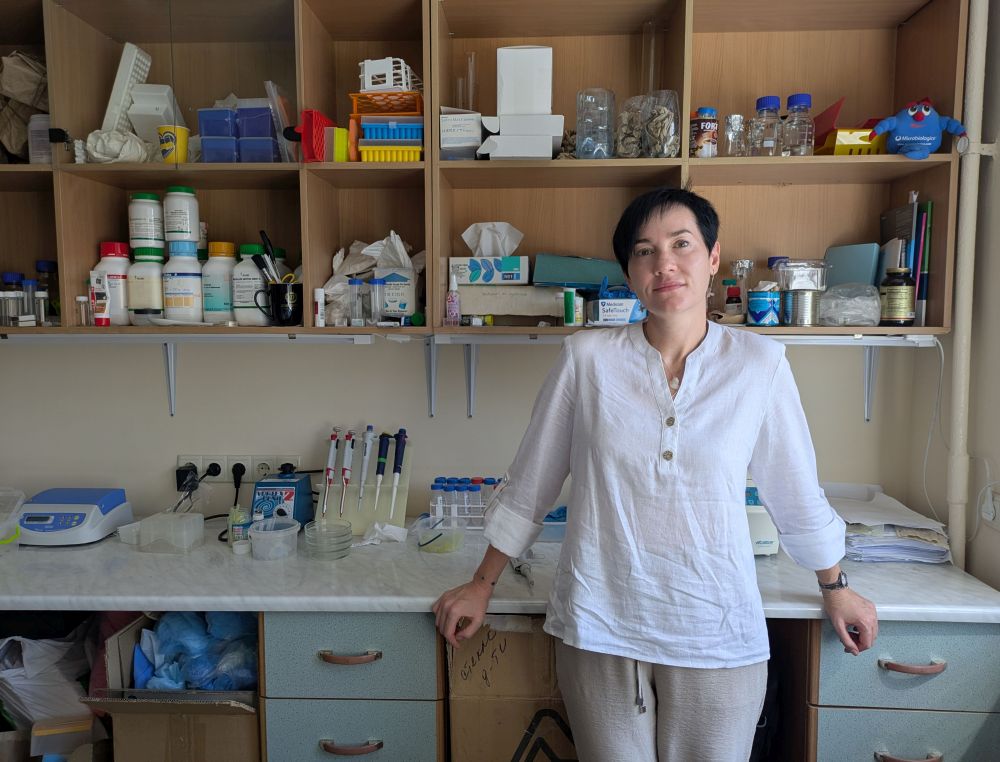
'I'm a biologist first and foremost,' says Dr Olena Moshynets, Ukrainian microbiologist and researcher. We are sitting in her office at the Institute of Molecular Biology and Genetics in Kyiv, which has a Soviet-era mural in the corridor and an array of pipettes and chemical instruments on the shelves. 'Stem cells, antibiotic resistance, the microbiome. They can all be studied through a lens of evolution and adaptation. We cannot see them simply as siloed medical problems.'
The issue of antibiotic resistance existed in Ukraine even before the full-scale invasion, but not necessarily for the reasons people think. 'The opinion is that people were incorrectly using antibiotics and so we have resistance, but this is only part of the issue,' Dr Moshynets says. 'The fight between bacteria and antibiotics has been continuing since long before humans. It's the natural adaptation process of an organism to its opponent.'
Dr Moshynets's background is in biofilms. These are clusters of bacteria surrounded by a protective layer, which can make infections particularly difficult to fight.
In research published earlier this year, Dr Moshynets and her colleague Hailie Uren observed that up to 37 percent of casualties reaching definitive care in Ukraine were carrying bacteria resistant to every available antibiotic, including the most potent carbapenems, typically reserved for only the most serious infections. They also found carbapenem-resistant bacteria that didn't carry the enzymes that normally cause resistance, leaving an open question as to how the resistance developed. These bacteria were not detected in 2022 and 2023, highlighting an emerging shift in resistance mechanisms.
During a war, infections are more likely to arise in fit and healthy young people who are wounded on the front. Their bodies can survive for a long time, while sub-optimal antibiotic treatment creates an opportunity for resistant bacteria to spread. The specific conditions of current drone warfare exacerbate the situation, because evacuating the wounded can take days or even weeks as drone coverage makes it too dangerous to move someone.
These issues are compounded by the pre-existing healthcare environment in Ukraine. 'Since its independence in 1991, Ukraine has had a lot of priorities, but medicine and science haven’t always been among them,' Dr Moshynets comments. 'This means that both the most experienced people, and the best antibiotics are not always available.'
A recent paper in The Lancet showed that a one percent increase in military spending is associated with an almost one percent reduction in public health spending in low-income countries.
With neither the time to test nor the availability of specialised antibiotics, wartime medics use whatever they have to hand. Dr Moshynets describes a patient in need of a 200,000 Ukrainian hryvnias course (just over £3200). 'But the patient is only allocated 100,000 hryvnias for their whole treatment. So, either the family needs to pay the difference, or we use whatever is available.'
Doctors may interpret a small improvement, such as a reduction in white blood cell count or a change in temperature, as progress. In fact, the infection is suppressed without being eliminated, allowing the more resistant bacteria to survive and multiply.
Unlike in the UK, where healthcare protocols have been honed over many years and more modern antibiotics are available, Ukrainian medics often need to innovate.
Dr Moshynets has been working with patients who have Gram-negative bacteria, which can be trickier to treat because they have an additional outer membrane that antibiotics find difficult to penetrate. She has been trying out a technique whereby she administers a relatively cheap antibiotic called azithromycin, after which Dr Moshynets saw an increased susceptibility to the more potent carbapenem antibiotics. She thinks this could be partially because azithromycin disrupts the outer membrane. Dr Moshynets notes that hospital purchases of azithromycin grew threefold last year, so she may not be the only one using this approach.
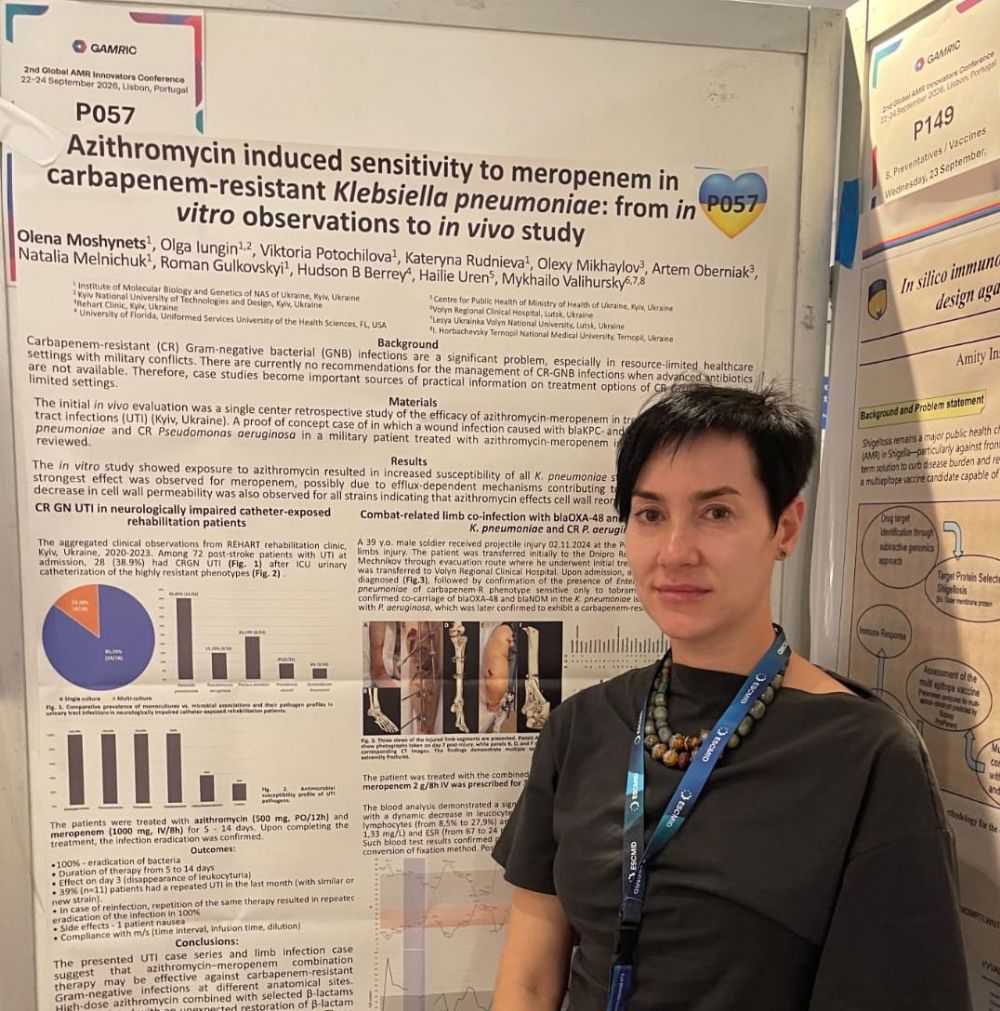
However, she is worried that she won't be able to fully study the efficacy of this type of treatment. As azithromycin is a generic drug, it is unlikely to provide incentives for trials by pharmaceutical companies. The cost is relatively low: around £8 a day for a single patient.
Standard infection-control techniques are even harder to maintain on the battlefield. Uren draws parallels between highly drug-resistant bacteria and biological warfare, where preventing spread is critical. She has proposed borrowing an approach in which the patient is decontaminated before an infection is established. This means cleaning wounds with antiseptics and removing clothing and dressings as soon as they enter a medical setting. Similar methods during the Iraq and Afghanistan wars were associated with lower rates of secondary infection.
'Medics in Ukraine are constantly trialling new techniques to prevent the spread of resistant bacteria,' Uren says. 'This is not only essential for Ukrainians, who are fighting a war they didn't ask for, but also for the biosecurity of Europe as a whole. We need to not relearn the lessons this war has taught us already.'
As we sit in Dr Moshynets's office, the air-alert signal wails in waves of higher and lower crescendo. We are far from any obvious targets, so we don't go to the shelter.
'If we had a peaceful time and a rich country, then we wouldn't have any problems at all,' Dr Moshynets says.
She shows me the spectrophotometer and confocal microscope in the building's basement. 'This is one of the reasons I haven't moved out of Ukraine since the war,' she jokes. 'I can't take it with me.' She shows me some of the images from her latest patient studies.
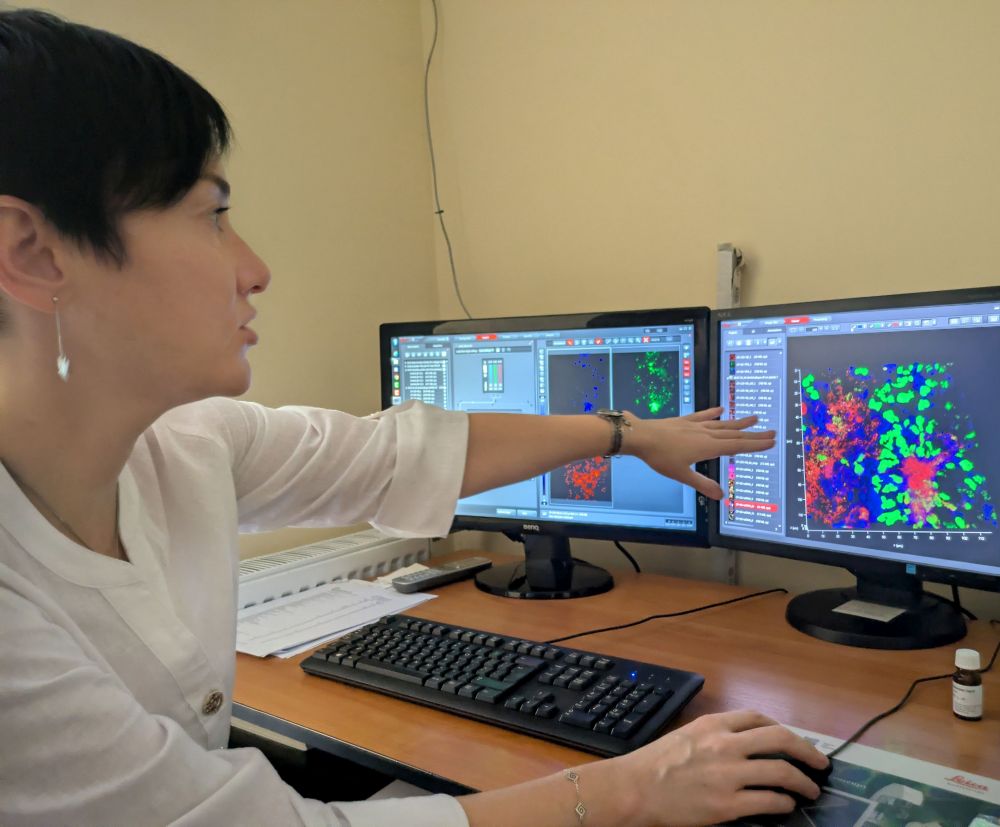
'Look at how beautiful these are,' she says. 'These pink and purple strands here show you exactly where the biofilm is being attacked by the immune system.'
Among her many projects, Dr Moshynets describes the trial injection of stem cells into a dog who developed severe brain damage after the removal of a tumour. 'The dog had awful seizures and a tremor, but after the stem cell injection, she was able to stand still for a brief period.' The impressive thing for Dr Moshynets, is that the improvement didn't wear off over time.
The cells needed to go from Kyiv to Dnipro, a seven-and-a-half-hour journey by train towards the frontline. 'Last time, they didn't get there because the post office was shelled. The package was delayed, so the cells defrosted and died,' Dr Moshynets explained. 'For the next attempt, we sent a specialist courier.'
Related Articles

Parenting beyond the grave: How war is changing reproduction in Ukraine and Israel
In Ukraine and Israel, war has turned posthumous reproduction into a legal and moral dilemma – one the law is still struggling to resolve...

'Heroes deserve to go home': The need for genetics in wartime Ukraine
While volunteering with nonprofit organisation Medical Life Lines Ukraine, which she co-directs, Dr Maria Botcharova visits a genetics lab in Kyiv and highlights the key issues faced there…

Use of dead soldiers' sperm approved in Ukraine parliament
Deceased Ukrainian soldiers' sperm does not have to be destroyed, and can be used by their partners posthumously, a legal amendment passed by Ukrainian MPs has confirmed...

Russian troops sent to Ukraine given opportunity to freeze sperm
Russian troops mobilised to fight in Ukraine will be offered sperm freezing and fertility treatment, it has been announced...

Reproductive Refugees – The effect of the Russian invasion on cross-border reproductive care
Since the closure of unregulated surrogacy destinations, Ukraine emerged as a massive hub for both donor eggs and surrogacy. The Russian invasion has had flow-on effects for cross-border reproductive care globally. Sam Everingham, of non-profit Growing Families, explains...
Podcast Review: Surrogacy, War, and Survival in Ukraine
The story Nadene Ghouri tells offers unique insights into not only the reality of transnational surrogacy arrangements, but also how the current situation in Ukraine is affecting both citizens generally and surrogacy in particular...
The impact of the war in Ukraine on the Russian fertility industry
The devastation caused by the Russian invasion of Ukraine on 24 February, as well as the unspeakable sufferings experienced by Ukrainian civilians have rightfully been at the centre of international attention...