

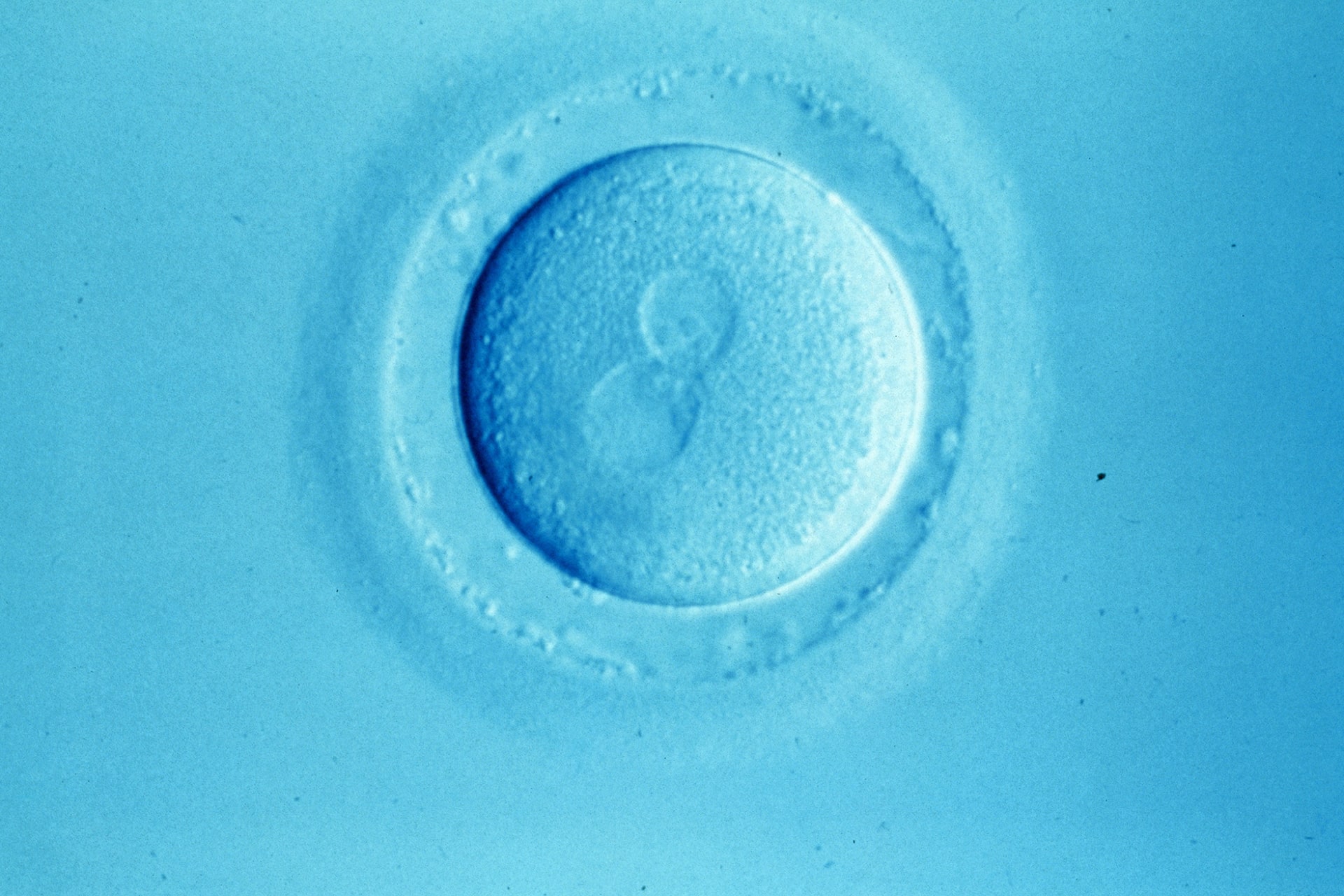
After watching and reviewing Katie Price's IVF journey last year (see BioNews 1280), I believed that the genre of the infertility confessional by a reality TV star had been well and truly scraped. Along comes 'Vicky Pattison – Maybe Baby', which proves that I was a) wrong and b) deluded about E4's ability to wring content out of reality TV celebs' first world, sorry, heartfelt personal dilemmas.
Vicky Pattison, reality TV star of Geordie Shore and Strictly Come Dancing as well as countless other shows in the same genre, is happily married with two labradors, an immaculate neutral-toned home and at the apex of her hard-won career. She is also 38 years old, and rightly outraged that her ovaries have been deemed 'geriatric' by her doctor while her husband's spermatozoa are fawningly praised as 'super-swimmers'.
Having frozen eggs and embryos in store, she has a back-up plan in case the craving for motherhood bites too late. For the moment, the craving is for a two-part fly-on-the-wall programme where she interrogates her wish for a baby through a number of set pieces (looking after a friend's young child, 'visiting' her embryos in the lab as well as a couple of slightly cringeworthy sessions with a sex therapist).
If all this sounds a little wearisome, it is because the programme leaves very little room for nuance. We learn that Vicky has premenstrual dysphoric disorder (PMDD) which leaves her feeling debilitated for half the month and with very low libido. This serious aspect of her life leaves Vicky wondering if she will be a good enough parent, which is a realistic concern; here, it is only one set piece where Vicky meets a friend and fellow PMDD sufferer who has children. The friend is able to reassure Vicky that despite the challenge of living with the condition, she is happy with her decision to pursue motherhood as an option.
Frequently referencing her status as the breadwinner in the family, it is clear that Vicky is worried about the repercussions of pregnancy and childbearing on her hard-won career. Her husband's laid-back stance is unconvincing, as he reveals he has just started a new business (another set piece with his father and brother). In what felt like a strikingly common-sense observation, his brother mildly observes 'You wouldn't be the only person with a job, dogs and children' to put paid to all the endless navel-gazing of this incredibly privileged couple. He has the good grace to nod in agreement.
The sex therapist prescribes 'simmering', a process which involves a series of complimentary texts throughout the day to keep the relationship on a positive trajectory, a welcome charcuterie board and chilled wine for Vicky when she gets home at night after a gruelling day's work. The charcuterie, or the wine (not clear which) seems to do the trick; smooching noises soon follow. All this is lovingly captured on camera, which means we are never able to forget this is a reality TV show and can always see the workings. Every tear, every kiss feels scripted, contrived and performative.
All the while, as she reinforces her desire for a child, Vicky reveals a lack of appetite for the actual logistics of pregnancy and child-rearing. She too is unconvinced by the vague assurances of other women (these include the friend with PMDD, a woman whose children have been born through surrogacy and a woman who has had a child through adoption, which she finds initially exciting before putting this aside too). The participants, unlikely to have been remunerated for their part in the programme, generously share their experiences and offer, as far as they can, genuine reassurance to Vicky's questions.
As a captive viewer, I had to remind myself that Vicky and her husband have no confirmed fertility issues that would exclude the possibility of a natural pregnancy. The programme makers obviously realised this, too; in response, they throw in another set piece where Vicky is sat in front of a set of results that profile her hormones. Reading the results off to camera, she seems almost non-plussed that they are normal, apart from an elevated oestradiol reading. It would have been better to have had a specialist on camera to interpret these lab results, but clearly no one could be found to participate in this non-event. It left me wondering about the genuinely devastating results women endure every day, and feeling little emotion for the reality TV playbook this programme serves up at every opportunity.
The resulting programme is a series of disjointed vignettes with the overarching premise that Vicky is uncertain about starting a family at a point when her fertility is waning and her career is giving her a lovely lifestyle which she is reluctant to interrupt (no judgement whatsoever). Exploring other options (adoption, surrogacy) would be sensible but despite a number of moving contributions, is edited to skirt over the surface and allow Vicky to become briefly excited by yet another scenario.
If this seems unnecessarily vitriolic, the couple seem genuinely warm and engaging. Vicky has an uninhibited, wicked sense of humour; at its heart, perhaps there is the unspoken truth that more people should question their decision to have children, as is increasingly the case with GenZ. At the end, Vicky and her husband ask the question that I was asking throughout the entire viewing: 'Is there a potential (sic) that we're overthinking this?'. Yes, but only for the purposes of the programme.
Sources and References
Related Articles


TV Review: Katie Price – Making babies
Part documentary and part fly on the wall reality TV, Katie Price – Making Babies, follows Katie and her partner at the time, Carl, as they undergo fertility treatment...


Film Review: The Donor Party
Susan Tranfield-Thomas turns her vitriolic disapproval onto this awful film, which she states is 'one of the worst films I've ever seen in my life and I was unlucky enough to sit through Scottish Mussel (2015, atrocious)'...
TV Review: Alex Jones – Making babies
A heartfelt, eight-part series follows presenter, Alex Jones, as she trains as a fertility assistant at King's Fertility, London, over a six-month period...
TV Review: Celebrity Health Stories – Nicola Adams, me and IVF
Elpida Fragouli reviews ITV's latest Celebrity Health Story, focusing on Nicola Adams' IVF journey with her female partner...
TV Review: Trying
Making comedy out of the ups and downs of the adoption process is a bold move by most standards. Infertility and comedy aren't, after all, the easiest of bedfellows, and there will be no shortage of people like myself, ready to roll our eyes at the first sign of cliché and censure any attempt to create cheap laughs...