

A stem cell model of the human amniotic sac, with the ability to mimic the tissues supporting the early embryo, has been developed to study the first weeks of development.
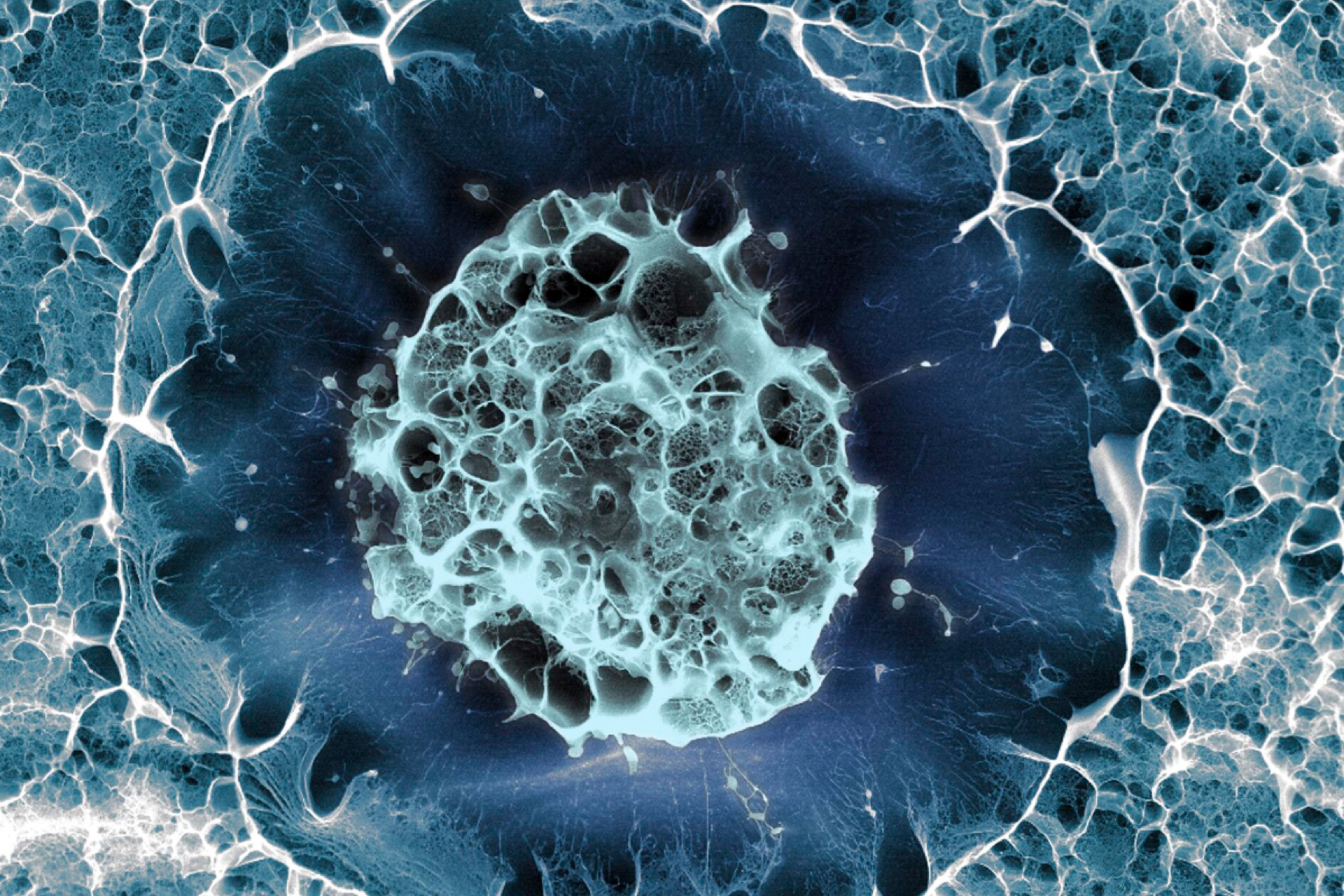
Researchers at the Francis Crick Institute, London, have created a 3D model that replicates the human amniotic sac in the first two to four weeks of embryonic development. Named post-gastrulation amnioid (PGA), this stem-cell-based model could help scientists understand the formation of extra-embryonic tissues and their interactions with the embryo during early development (see BioNews 1200).
'This model replicates the mature human amnion for the first time, closely mimicking the structural and functional traits of the human amniotic sac with high reproducibility. This gives researchers a tool to investigate later stages of human development and the functions of tissues supporting the embryo,' said Dr Borzo Gharibi, first author of the study published in Cell. 'Supporting tissues like the placenta, like the amniotic sac, grow with the embryo and are really important for the embryo's growth and survival,' added senior co-author Dr Silvia Santos.
The amnion is a thin, transparent membrane that forms a fluid-filled sac surrounding the embryo during pregnancy. Initially thought to be responsible for cushioning and protecting the embryo, it has been recently shown to be a source of signals that help pattern the embryo into the necessary cell types. The study of supporting membranes like the amniotic sac is limited by the ethical and technical restrictions of obtaining human embryos at such early stages. This stem-cell model, the first to replicate the 3D structure, provides an alternative to current studies in other mammalian species which do not accurately reproduce human development.
To create the organoids, researchers used human embryonic stem cells, pluripotent cells with the ability to generate all body cell types. They cultured these cells with two signalling molecules, one the first day, and another the following day. Treated cells then organised themselves into the inner and outer layers of the amnion and grew into fluid-filled sacs for over 90 days.
The reported high reproducibility (90 percent sac-like structures by day ten) makes PGAs an attractive tool to study the formation and function of supporting tissues, learn how cells develop, which genes are essential and which signalling molecules are important.
'Early human development is still a black box due to ethical and technical constraints, but our new model gives some visibility during this critical time, without needing to use human embryos. This work shifts our view of the amnion as just a protective structure: it might be actively talking to embryonic cells and promoting their growth, explained Dr Santos.
Beyond its role in embryo protection and patterning, the amniotic sac membrane produces proteins with regenerative properties that can be used in the clinic for burn treatments or cornea reconstruction. However, amniotic sacs can only be obtained from donations after caesarean sections.
'We're also excited about the potential of PGAs as a fast, cheap and scalable way to provide amniotic membranes for medical use,' added Dr Santos.
Sources and References
Related Articles

What are the morally relevant features of stem-cell-based embryo models?
Dr Naomi Moris and an international group of colleagues propose three broad categories of ethical value and five categories of morally relevant biological features that can inform oversight of research involving human stem-cell-based embryo models...

Blood cell development seen in human embryo model
A human embryo model created from adult stem cells shows the production of blood cells during early development...
Creation of a complete day 14 human stem-cell-based embryo model
The most complete human embryo model to date has been created, mimicking all of the key structures that emerge in the early embryo by day 14 of development...
Human stem-cell-based embryo model forms amniotic cavity and yolk sac
A human stem-cell-based embryo model which includes some of the supporting structures required for embryonic development may enable further understanding of the earliest stages of human embryogenesis...