


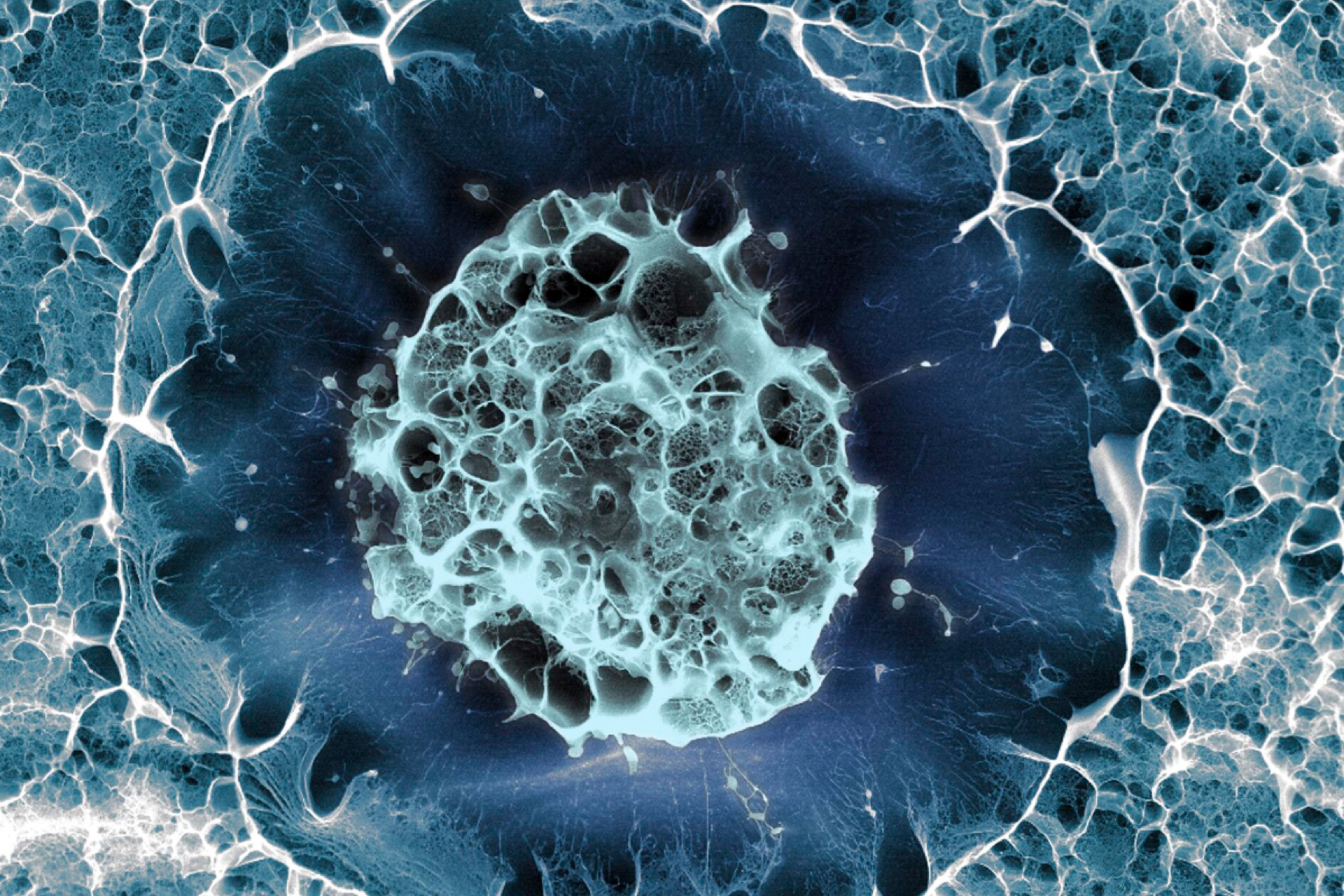
Swapping one sugar for another leads stem cells to become 'fitter and younger' versions of themselves, new research has revealed.
In a study performed by the University of Copenhagen, Denmark, mouse embryonic stem cells were grown in a cell culture medium containing D-galactose instead of the standard D-glucose. Swapping the sugars caused the cell's metabolism to switch from glycolysis, a fast but inefficient process, to oxidative phosphorylation, a more efficient but slower process, which led to improved cell health and versatility.
'We show that by changing their diet, the stem cells can rejuvenate and turn into "super stem cells",' said Dr Robert Bone, assistant professor at the Novo Nordisk Foundation Centre for Stem Cell Medicine at the University of Copenhagen, and first author of the study published in The EMBO Journal. 'It forces them to metabolise their energy in a different way than they normally would, and that process essentially reprogrammes the cells. The net result is that they behave like they are from an earlier stage of development, which enhances their ability to develop, or differentiate, into other types of cells.'
Stem cells are undifferentiated cells and have the potential to develop into any type of bodily cell, such as liver, skin or nervous cells. They are usually developed as cells from a mammal's embryo and grown ex vivo in a cell culture featuring a sugar-rich growth medium.
A key application of stem cells is improving fertility treatments, such as IVF. The inner cell mass, or embryoblast, is a mass of cells within the blastocyst during the early development of an embryo. Cells of the inner cell mass are pluripotent and can give rise to all three germ layers of the developing embryo, forming both embryonic and extra-embryonic tissue. The extra-embryonic tissues, such as the placenta and the yolk sac, are critical for an embryo to develop during pregnancy and are crucial for embryo implantation in the uterus.
'One of the things that the "super stem cells" seem to be better at making is a cell lineage that becomes something called the yolk sac. Previous research has found that the formation of the yolk sac in embryos cultured in a dish is very important for their ability to implant and become successful pregnancies,' said Dr Bone.
When the scientists changed the type of sugar in the medium the stem cells were grown in, they found that the cells were healthier and better at differentiating. Triggering oxidative phosphorylation activates specific enzymes to remove the acetyl groups from histones and transcription factors. This enables DNA with irrelevant genes to be more tightly coiled around the histones, while enabling more important genes to be exposed and thus expressed.
Furthermore, transcription factors with fewer acetyl groups can bind to target DNA sequences more accurately and express the desired genes without expressing unintended genes, referred to as transcriptional noise. The removal of transcriptional noise helps each stem cell express genes associated with differentiation into a specific cell lineage rather than expressing genes of different lineages.
Beyond aiding reproductive treatment, the researchers hope these rejuvenated stem cells could also play a key role in regenerative medicine, where damaged tissue is either repaired or replaced.
'Perhaps we could use this trick to regenerate aging cells and treat diseases such as Parkinson’s disease, osteoporosis or diabetes,' said Professor Joshua Brickman, from the Novo Nordisk Foundation Centre for Stem Cell Medicine, and corresponding author of the study.
Sources and References
-
Researchers create 'super stem cells', seeing potential for improved fertility treatment
-
Altering metabolism programs cell identity via NAD+-dependent deacetylation
-
Sugar swap leads to sweet spot in creating 'super stem cells'
-
Researchers create 'super stem cells' that could improve fertility treatment
-
Super stem cells become better versions of themselves by changing their diet
Related Articles
Skin stem cells have potential to fight cancer
A new technique to transform skin cells into immune cells has been used in the laboratory to hunt for and attack cancer, report scientists after a proof-of-principle study...
Stem cell treatment in irradiated rats offers hope for radiotherapy patients
Following radiation to the head, rats transplanted with stem cells had greater improvements in learning and memory, showed a research team at the University of California....
Stem cells and neurons generated from ALS patients' skin cells
Scientists at the Harvard Stem Cell Institute and the Columbia University Medical Center in the US have reprogrammed the skin cells of two patients with amyloid lateral sclerosis (ALS), making induced pluripotent stem (iPS) cells. The stem cells were then used to generate motor neurons - the nerve...
Cell transplant hope for eye diseases
Two new studies show that cell transplants could be used to treat people with vision problems. US scientists have managed to restore the sight of a woman affected by retinitis pigmentosa, an inherited eye disease. However, the research has sparked controversy, since the team used a sheet of retinal cells...
Mouse 'super stem cell' discovered
An adult stem cell that may have the potential to grow into any other type of cell in the body has been found in the bone marrow of mice. This may offer the promise of treatment or cures for many human conditions, but without the ethical problems that surround the...