


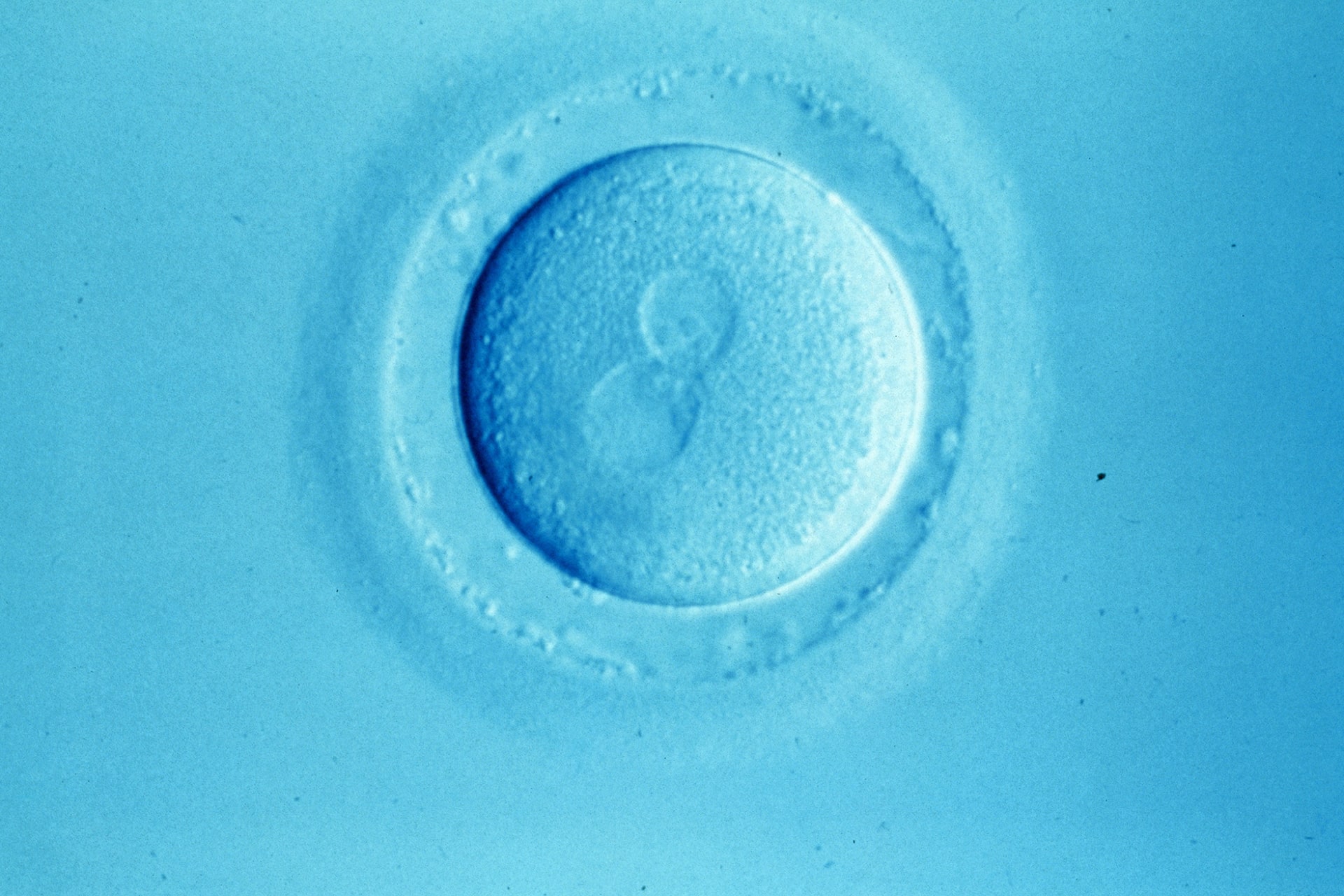
It's not every day you get to enjoy the sight of an eminent academic colleague in a skin-tight full body leotard, but that was just one of the treats in store for me when I went along to The Stand Comedy Club to see Professor Rod Mitchell's Edinburgh Fringe show, Spermageddon: Thirty Minutes to Save Humanity.
The show tackles the thorny topic of declining male fertility. A slew of recent headlines has warned us that 'society is running out of babies', birth rates are falling and men are facing an impending Spermageddon. The data behind the panic comes largely from a 2017 research project that pooled data from 185 studies looking at sperm counts in around 43,000 men, and reported that sperm concentration in men from North America, Europe, Australia and New Zealand had fallen by more than half between 1973 and 2011. A more recent update widened the net to include men from South and Central America, Asia and Africa and found much the same; average sperm concentration dropped from around 101 to 49 million sperm per millilitre between 1973 and 2018, and the decline seems to be speeding up after 2000.
So far, so apocalyptic. At this rate the human tadpole population will be extinct by 2060, and we'll be in big trouble. Thankfully, before we start running screaming for the emergency exits, there are a few wrinkles in this data to point out. Most of these studies weren't designed to track changes over time and how we count sperm has changed along the way. Also, the man who gave a sample in the 1970's had sideburns, a Ford Cortina and a forty-a-day habit whereas today's counterpart has a Fitbit, a flat white and a laptop balanced on his crotch for eight hours a day. Some researchers would argue that this is like comparing apples and oranges (or should that be plums and walnuts?) and the differences in sperm count reflect normal variations between populations rather than a steady global slide.
It's also worth pointing out that 49 million sperm per millilitre is still within the normal range; the chance of conception only starts to dip once we drop below 40 million sperm per millilitre. As Professor Mitchell explained, while there is a decline in sperm health, the causes are also disputed. Our environment gets a bad rap – from chemicals and plastics, to diet and obesity – while others argue delaying parenthood until later in life explains the fall in birth rates far more than anything that's going on inside the love spuds.
Whisking us forward to 2126 in his metaphorical time machine, which I imagine looks like Jeff Bezos's New Shepard, Professor Mitchell ponders what a post-Spermageddon future might look like. We entered a world in which men are, biologically speaking, optional; where human gametes can be made in a lab from skin cells, which was funny until we learned that scientists have already achieved this in mice. The men in the audience looked decidedly uncomfortable at this point. The women, somewhat interested. Is this what we want – and who gets to decide?
Before we got too comfortable with the idea of a man-free future, Professor Mitchell reminded us that the present-day version still has his uses, warmly congratulating an unsuspecting man in the audience on the sperm he had been making throughout the show, somewhere in the region of a thousand sperm per second, without lifting a finger. Great work lads!
And then there was the leotard. The image of which remains burned into my retinas. It's one thing to hear a professor talk about sperm, but quite another to watch him become one. Professor Mitchell showed impressive motility for a man of his standing and, while nobody was counting, I'd put him in the normal range! He concluded that while 'the average number of swimmers in a teaspoon of gentleman's relish' is indeed declining and we can't say for certain why, we do have some tools at our disposal to help improve male fertility. We don't need to start building the bunkers quite yet.
Continuing on top form from last year's show Talking Bollocks (see BioNews 1301), in which he took on the topic of fertility preservation for children undergoing chemotherapy (a topic most of us would struggle to raise at a dinner party, let alone in a comedy club), Professor Mitchell took us on a raucous ride with Spermageddon. He has a real knack for finding the humour in difficult topics without losing sight of the people living with these issues; his jokes are what carry serious messages to audiences who may otherwise never hear them.
Male infertility is common. In around half of couples who struggle to conceive there is a male factor involved, but men rarely talk about it and many go through tests and treatments keeping it all to themselves. Getting a room full of strangers to laugh out loud about sperm is no mean feat. If a few men in that audience go home and find it a wee bit easier to talk to their partner, a pal or their GP, then that can only be a good thing.
In a surprise to absolutely nobody, the message lands far better coming from an eejit in a skin-tight leotard in a comedy club, than a professor in a suit in a lecture theatre.
Sources and References
Related Articles


From nuclear bombs to nuclear genomes
Professor of stem cell science, Dusko Ilic, discusses concerns raised by the plans of a US-based startup – the (new) Manhattan Project – to create genome-edited babies…
South Africa may allow heritable human genome editing
In a significant update to its health research ethics guidelines, South Africa has introduced a new framework covering heritable human genome editing...
Podcast Review: Make People Better
A podcast series to accompany the film 'Make People Better' gives unique insights into the controversial creation of genome-edited babies by Dr He Jiankui...
China's ethics guidelines – A new era for human genome editing?
What do China's new ethical guidlines tell us about the country's changing attitude to human genome editing? Professor Joy Zhang reads between the lines...
Ethical guidelines for human genome editing research published in China
New guidelines concerning the ethics of human genome editing research have been set by China's Ministry of Science and Technology...

Podcast Review: Babbage – The hopes and fears of human genome editing
After virtually attending the Third International Summit on Human Genome Editing, Rebecca Robb revisits some of its most interesting parts in an episode from the Economist's podcast, Babbage...
Event Review: Third International Summit on Human Genome Editing
Australian student, Rebecca Robb, attended the Third International Summit on Human Genome Editing online. Read her views here...
Regulatory questions remain following global summit on genome editing
Concerted regulation of human genome editing technologies and their applications is still needed, was the consensus at the Third International Summit on Human Genome Editing...
Radio Review: Genetic Dreams, Genetic Nightmares
Hosted by Professor Matthew Cobb of the University of Manchester, Genetic Dreams, Genetic Nightmares took me back to his lectures during my undergraduate degree there...
WHO publishes guidelines for human genome editing
The World Health Organisation has released new guidelines for the governance of genome editing in humans...