


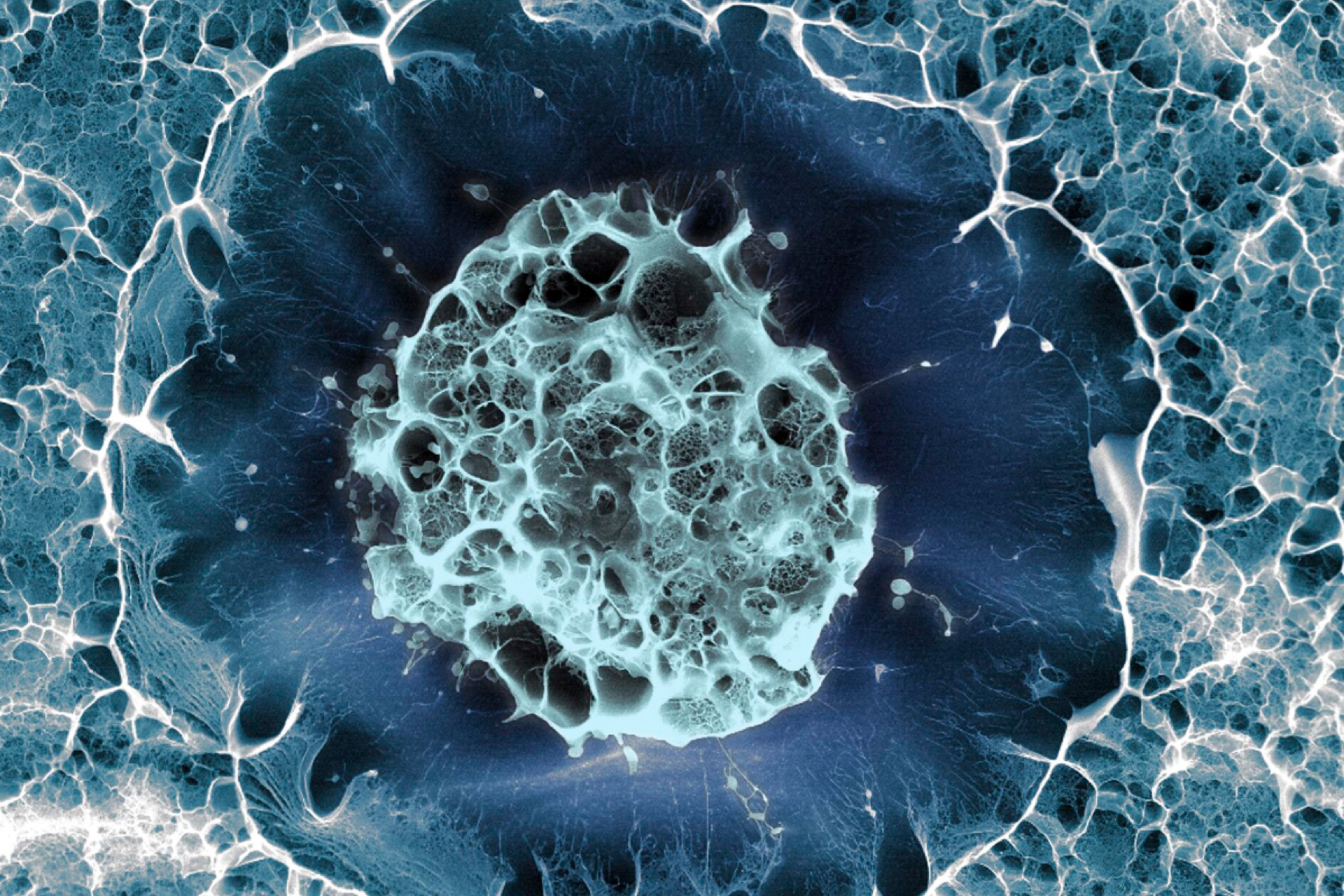
Neural organoid research uses stem cells to create small, three-dimensional models that can mimic aspects of brain development and function. As organoids become more sophisticated, their capacity to replicate features associated with brain function will increase, bringing excitement and optimism about their promise for understanding more about human brain development and disease.
The Nuffield Council on Bioethics (NCOB)'s Neural Organoids Working Group, which I chair, has been considering the ethical issues that could arise as the science of organoids develops. Our work has been informed by contributions from a range of people involved in neural organoid research, including funders, scientists and regulators, as well as through an open call for evidence.
In our recent report Neural organoids: Ethical and governance considerations, we made a series of recommendations, each part of an overall approach aimed to support valuable research using neural organoids while strengthening ethical safeguards and public trust.
First, having identified significant governance gaps that leave researchers, institutions, and oversight bodies operating without shared ethical parameters or clear guidance, we are calling for the development of best practice guidance to improve consistency and to support responsible decisionmaking in this area of research. This would reduce uncertainty for researchers and ethics committees, and help to align practice with evolving public expectations. In our view, an interdisciplinary alliance – including tissue banks, research funders, regulators, and professional bodies – should work together to produce this guidance.
While we acknowledge that neural organoids do not currently display indicators of biological complexity associated with sentience, we strongly believe it is sensible to have guidance in place that anticipates future developments as the science evolves, and that supports researchers in identifying developments requiring closer ethical attention. A key focus of the best practice guidance, then, should be to develop a shared definition of what is meant by 'sentience' in the context of neural organoids and similar models, and to identify model characteristics, experimental steps, or research features that may indicate the possible development of sentience in the future.
Animal welfare is an issue that the Working Group returned to repeatedly. As research in this area progresses, an important question will be whether transplanting human neural organoids and similar models (rather than isolated human neural stem cells) into nonhuman animals could significantly alter the behaviour or cognitive abilities of the animal host. For example, researchers may need to consider whether neural organoid transplantation could affect an animal's capacity to suffer or to experience pleasure, and – if so – what proportionate regulatory mechanisms would be needed to ensure appropriate animal welfare protections.
The best practice guidance we recommend therefore needs to address animal welfare, particularly in relation to the transplantation of human organoids into non-human animals. We further recommend that Home Office guidance on the use of human material in animals be updated to explicitly account for the transplantation of human neural organoids into nonhuman animals, and to reflect developments in the wider ethical and regulatory landscape on animal sentience.
Another important issue to address in the short term is consent, ensuring that tissue donors are appropriately informed about potential future uses of their donated material. Our recommendation is that research institutions and biobanks review and update their informed consent policies and practices for the donation of human fetal, embryonic, and adult tissue used in stem cell and organoid research, including information about possible uses of donated tissue in neural organoids and similar models.
We are clear that public engagement to explore UK public attitudes towards neural organoid-related research – including people with lived experience of brain conditions and tissue donors – is a crucial part of this process, and should underpin the development of future guidance and oversight. We therefore recommend that funders of research involving neural organoids and similar models invest in robust public engagement.
The case for anticipatory regulation
Neural organoids exemplify a broader pattern across emerging biotechnologies – including in vitro derived gametes and stem cell-based embryo models, as also highlighted by NCOB (see BioNews 1267) – where the UK's regulatory system is struggling to keep pace with innovation.
An out-of-date or lagging system is a problem for several reasons, chief among them being that research perceived to be advancing without appropriate ethical safeguards risks damaging public trust in innovation, which has recently been shown to be somewhat fragile. Another related concern is that the speed of scientific development can prompt sudden, disproportionate policy responses that risk halting research in its tracks.
While scientific progress often advances rapidly and unpredictably, law reform is typically a lengthy, inflexible process. Introducing new laws or amending existing ones to regulate a specific biotechnology therefore risks creating rules that quickly become outdated or obsolete as research evolves. An anticipatory approach to the regulation of emerging biotechnologies is therefore needed, so that rules can be introduced and amended in a timely way.
With this in mind, we welcome the signal in the King's Speech that, via the Regulating for Growth Bill, the Government is planning to rethink its approach to the governance of emerging biotechnologies (see BioNews 1339). We hope that the Department for Science, Innovation and Technology and the Department of Health and Social Care will build upon existing work, including through the Regulatory Innovation Office, to scope a range of proportionate approaches to the future statutory regulation of new biotechnologies which balance responsiveness with regulatory stability and clarity.
The aim should be to ensure that, when evidence indicates a need to move toward statutory regulation of a biotechnology, action can be taken swiftly so that risks are identified and mitigated and the benefits of innovation can be realised for society safely and in a timely way.
Related Articles

What are the morally relevant features of stem-cell-based embryo models?
Dr Naomi Moris and an international group of colleagues propose three broad categories of ethical value and five categories of morally relevant biological features that can inform oversight of research involving human stem-cell-based embryo models...

The case for adaptive governance in emerging biotechnology
Professor Emma Cave explores how adaptive governance and regulatory sandboxing could help the UK support emerging biotechnologies while maintaining public trust and effective oversight…
Brain organoids could guide treatment of Alzheimer's disease
Brain organoids, and the tiny particles they secrete, may help to stage early Alzheimer's disease and evaluate drug response...


Developing an international framework for stem-cell-based embryo models
Professor Alfonso Martínez Arias, Dr Nicolas Rivron and Dr Naomi Moris set out key recommendations from a foundational framework for research, technological development and regulation in relation to stem-cell-based embryo models...

Brain organoids help identify Alzheimer's drug target
A potential new gene target for Alzheimer's disease treatment has been identified using brain organoids...
Human stem-cell-based embryo models: ethical and legal challenges
Professor Emma Cave argues that even if human stem-cell-based embryo models were to replicate embryos so accurately that they ceased to be 'models', there would still – even then – be good reasons to distinguish them from embryos for regulatory purposes…
Futureproofing ethical SCBEM innovation
The Nuffield Council on Bioethics has published recommendations calling for clear legislative action to differentiate stem-cell-based embryos from embryos and to safeguard against ethical breaches...

Event Review: The Ethics of Engineering Biology – An NCoB workshop
The Nuffield Council on Bioethics gathered scientists, policymakers, regulators and ethicists for an afternoon of talks and discussion on the ethical implications of engineering biology...