

Brain organoids, and the tiny particles they secrete, may help to stage early Alzheimer's disease and evaluate drug response.
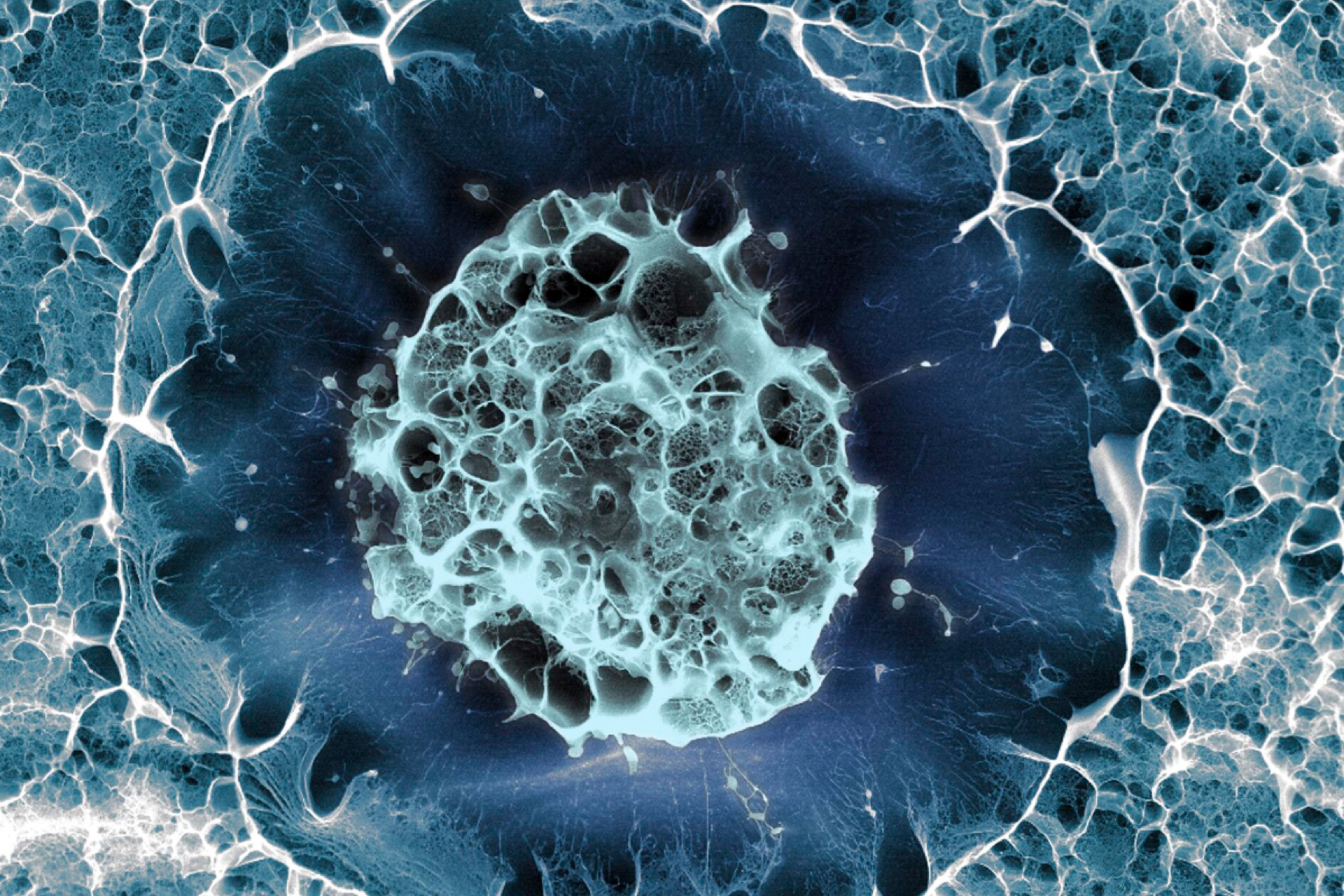
Brain organoids are three-dimensional brain tissues derived from stem cells that mimic aspects of brain function and are sometimes referred to as 'brains in a dish' (see BioNews 1300, 1245, 1223 and 1177). These organoids also secrete extracellular vesicles, small particles that contain cellular information. Now, researchers have generated patient-derived organoid models and analysed protein profiles from both the organoids and their extracellular vesicles. They aimed to better understand Alzheimer's disease mechanisms and explore sources of variation in individual drug responses.
'Our study suggests that large-scale, patient-derived brain organoids and the vesicles they secrete can help us stage Alzheimer's disease, investigate the mechanisms that drive it and assess how patient subgroups may respond to different treatments,' said Dr Vasiliki Machairaki, associate professor of genetic medicine at Johns Hopkins University in Baltimore, Maryland, who led the study published in Alzheimer's & Dementia.
The researchers generated organoids derived from stem cells collected from blood samples of 30 people, including both Alzheimer's patients and cognitively normal controls. They showed that organoids and secreted extracellular vesicles can reflect molecular-level changes associated with Alzheimer's disease. The organoids revealed changes in immune activity, brain development pathways and communication between nerve cells.
The organoids were also used to assess responses to selective serotonin reuptake inhibitors (SSRIs) – a common class of medication used to manage neuropsychiatric symptoms associated with Alzheimer's disease – helping to explain why they may be effective in some patients but not others.
Extracellular vesicle profiles showed distinct molecular responses to medication, which may help predict individual differences in treatment response in future applications. The extracellular vesicles highlighted changes in neuronal communication, memory-related pathways and other key brain functions.
'We used these organoids to model how some patients' tissue may respond to a commonly prescribed SSRI,' said Dr Machairaki. 'On a large-scale level, our model may eventually be used to identify subgroups of patients, based on underlying molecular mechanisms, who are more likely to respond to certain drugs and thus help us to create precise, targeted treatments in the long run.'
For future work, the team plans to incorporate immune cells and vascular-like networks into the model to improve its biological accuracy and better mimic the structure of the human brain, as well as explore the use of extracellular vesicles for diagnosing and staging subtypes of Alzheimer's disease.
Overall, the study suggests that brain organoids and their secreted extracellular vesicles may serve as useful experimental models for understanding Alzheimer's disease heterogeneity and could, in the future, support more personalised approaches to treatment selection.
Sources and References
-
Mini lab-grown brains could help treat, diagnose, and stage Alzheimer's
-
Mini brain-like structures grown in lab may help scientists treat, diagnose and stage Alzheimer's disease
-
Proteomic profiling of brain organoids and extracellular vesicles identifies early Alzheimer's disease biomarkers and drug response heterogeneity
Related Articles

Salivary gland organoids developed from human pluripotent stem cells
Human salivary gland organoids derived from pluripotent stem cells have been transplanted into mice....
Human brain tissue grows and connects inside engineered mice
Human organoids transplanted into mouse brains can grow and form connections with the surrounding nervous system...

Human brain organoids kept for more than five years in a dish
Human brain organoids have been kept in culture for more than five years, extending the period over which these models of human brain development have previously been maintained...
Drug candidate targets DNA damage in Alzheimer's disease model
A drug candidate previously tested for safety in humans has reduced several disease-associated features in a mouse model of Alzheimer's disease...
Human organoids suggest that 'irreversible' nerve damage might be reversed
A developmental mechanism that restricts nerve regeneration has been identified using neural organoids...
Book Review: Disembodied Brains – Understanding our intuitions on neuro-chimaeras and human brain organoids
Professor John Evans explores public and expert views on human brain organoids and neural chimaeras. He highlights the tension between scientific promise and public unease, providing an essential guide for anyone working with these emerging technologies...
Brain organoids help identify Alzheimer's drug target
A potential new gene target for Alzheimer's disease treatment has been identified using brain organoids...
Chimeric brain organoid created using stem cells from five people
Stem cell lines from multiple human donors have been combined to create 3D brain organoids for the first time...
Better standards for creating brain organoids proposed
Conditions that are favourable to growing good quality brain organoids have been demonstrated by University of California scientists...
Brain organoids reveal effect of sodium valproate on prenatal brain
New research using brain organoids suggests that stem cell senescence, where cells are halted in a suspended state, is responsible for the fetal brain changes caused by sodium valproate...