

Disembodied Brains: Understanding our Intuitions on Neuro-Chimaeras and Human Brain Organoids
By Professor John Evans
Published by Oxford University Press
ISBN-10: 0197750702, ISBN-13: 978-0197750704
Buy this book from Amazon UK
After reviewing the Human Developmental Biological Initiative (HDBI) ethics seminar by Professor John Evans late last year, and giving it a thumbs up (see BioNews 1315), the PET team asked me to review his book Disembodied Brains. The book is a deep dive into his own research on the US public's opinions about human brain organoids and neural chimaeras.
I sat down to get reading and immediately had to get a pen and paper to take some notes. That is to say that this book is not a relaxed, holiday read, but felt more like sitting down to read a 250-page research paper. However, in an age where everything comes in 20-second, pre-packaged snippets, taking the time to sit down and immerse myself in one single topic felt like a privilege. As a PhD researcher working with brain organoids, this book also felt like an important topic for me to understand further.
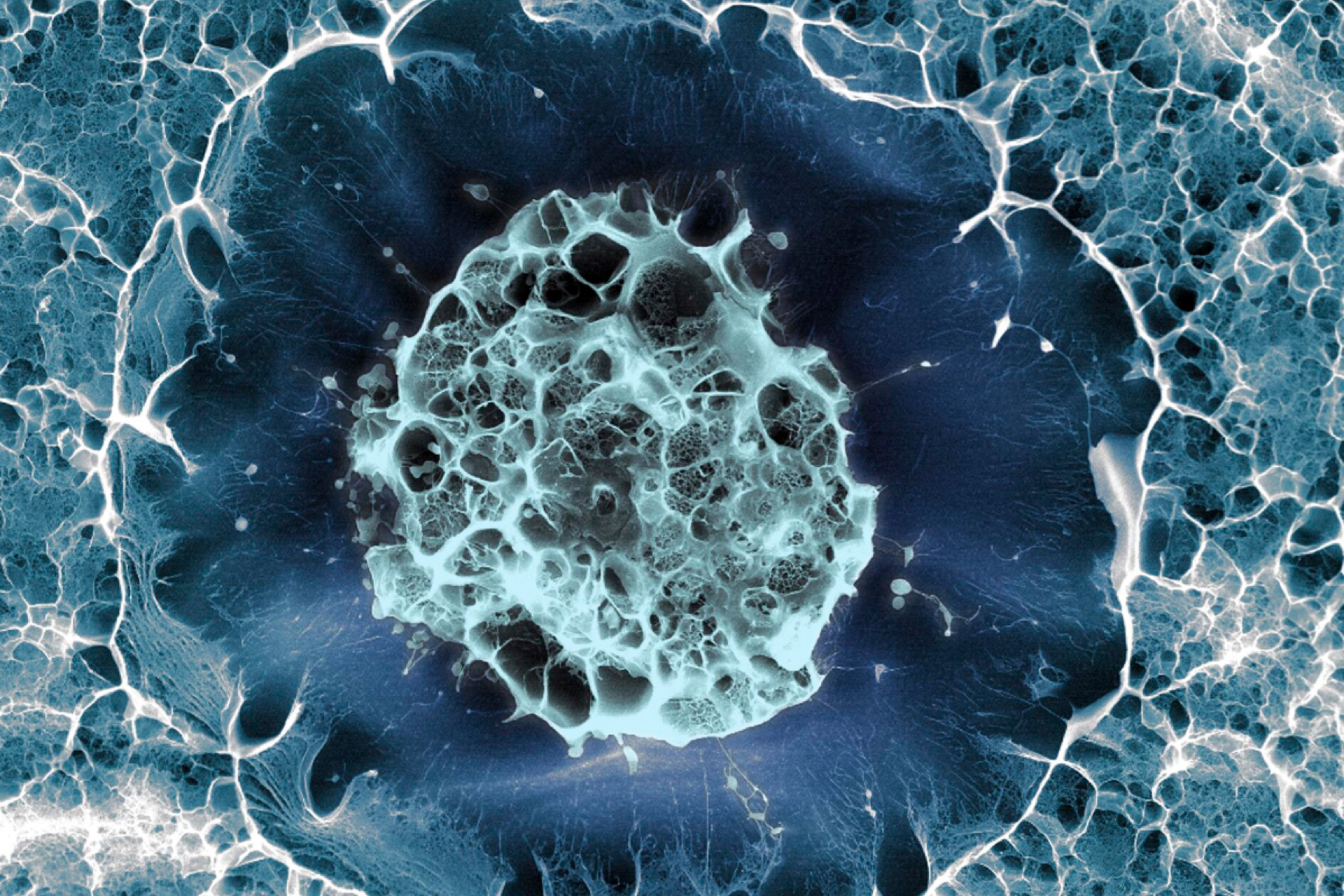
Brain organoids are three-dimensional clusters of brain cells, grown in a lab, which mimic some elements of the developing human brain. Scientists can take these brain cells and implant them into the brain of an animal, usually a rodent, resulting in a human-animal neural chimaera. Such models provide deeper insights into brain development and neurological diseases. To the scientific community, these technologies are an exciting and positive step forward, offering a 'window' into the living human brain, something otherwise inaccessible.
However, to date, public opinion on these technologies has received little attention. Neither have discussions or questions regarding brain organoids and neural chimaeras, such as: 'whose ethics should shape public policy?'. Professor Evans's research aims to address this gap through surveys that explore differences in perspectives among scientists, bioethicists, and the general public. This book provides a detailed and thought-provoking summary of his findings.
The first chapter meticulously explains the relevant philosophical theories, scientific concepts, research methodology and the bioethics approaches that are referred to throughout the book. This foundation sets the stage for the complex discussions that follow.
Professor Evans closes the chapter with a compelling quote from lawyer and bioethicist Professor Henry Greely: 'If it looks like a human brain and acts like a human brain, at what point do we have to treat it like a human brain – or a human being?'
This immediately drew me in, and I was keen to read on and learn more.
Further to uncovering public opinion, Professor Evans also investigates the core beliefs underpinning these views. The subsequent chapters offer a nuanced exploration of these perspectives, helping the reader appreciate the subtleties of public sentiment.
Professor Evans observes that scientists working with these technologies no longer have the 'visceral "yuk" response' that the public often expresses, which I can personally attest to. However, Professor Evans's choice to include quotes from interviewees gave me a better understanding of why and how people might feel such things and really brought the book to life.
One interviewee, Jane, captures the tension vividly: 'I don't know. It just starts to sound a little too much like playing God, but what if it became a real thing? I don't know. That would be a little creepy, because then, what do you do with it if it's a real thing and got out of control, something like a bad science-fiction movie?'
As I noted in my previous review of this work, a more diverse group of participants, outside the USA would provide a greater and more well-rounded insight into the views of the public on such topics. Broader studies would be key in drawing further conclusions. However, Professor Evans's research and this book represent the first fully comprehensive examination of this topic and provide an interesting and helpful framework for future studies.
Professor Evans concludes: 'I hope that, at minimum, I have provided the reader with an intellectual basis for continuing to engage with these issues.'
For me, he has more than achieved that. Disembodied Brains inspired me to explore the world of bioethics more deeply. It guides readers through tricky philosophical concepts and provides a good foundation to build upon. For anyone working with brain organoids or human-animal neural chimaeras, this should be your next read.
Buy Disembodied Brains: Understanding our Intuitions on Neuro-Chimaeras and Human Brain Organoids from Amazon UK.
Sources and References
Related Articles


Human brain organoids kept for more than five years in a dish
Human brain organoids have been kept in culture for more than five years, extending the period over which these models of human brain development have previously been maintained...
Human organoids suggest that 'irreversible' nerve damage might be reversed
A developmental mechanism that restricts nerve regeneration has been identified using neural organoids...
Brain organoids could guide treatment of Alzheimer's disease
Brain organoids, and the tiny particles they secrete, may help to stage early Alzheimer's disease and evaluate drug response...
Event Review: HDBI Ethics Seminar – Ethics of human brain organoids and human-animal chimaeras
Professor John Evans gives an insightful talk about the US public's opinion on the use of human brain organoids and human-animal chimaeras in research...

Event Review: The Ethics of Engineering Biology – An NCoB workshop
The Nuffield Council on Bioethics gathered scientists, policymakers, regulators and ethicists for an afternoon of talks and discussion on the ethical implications of engineering biology...

Event Review: The Royal Society – Remaking ourselves
What does it mean to be human? Have you ever questioned the meaning of self or humanity? Dr Yee Yen Goh reviews the Wilkins-Bernal-Medawar 2022 award lecture, given by Dr Philip Ball...
Podcast Review: The Big Question – Using human brain cells in rats to understand psychiatric disorders
A new study, published in Nature, by world-renowned Stanford neuroscientist Professor Sergiu Pasca involved the transfer of human brain organoids into the brains of rats. Here, Dr Insoo Hyun, director of the Centre for Life Sciences and Public Learning at the Museum of Science in Boston, Massachusetts, speaks with Professor Pasca about his research...