


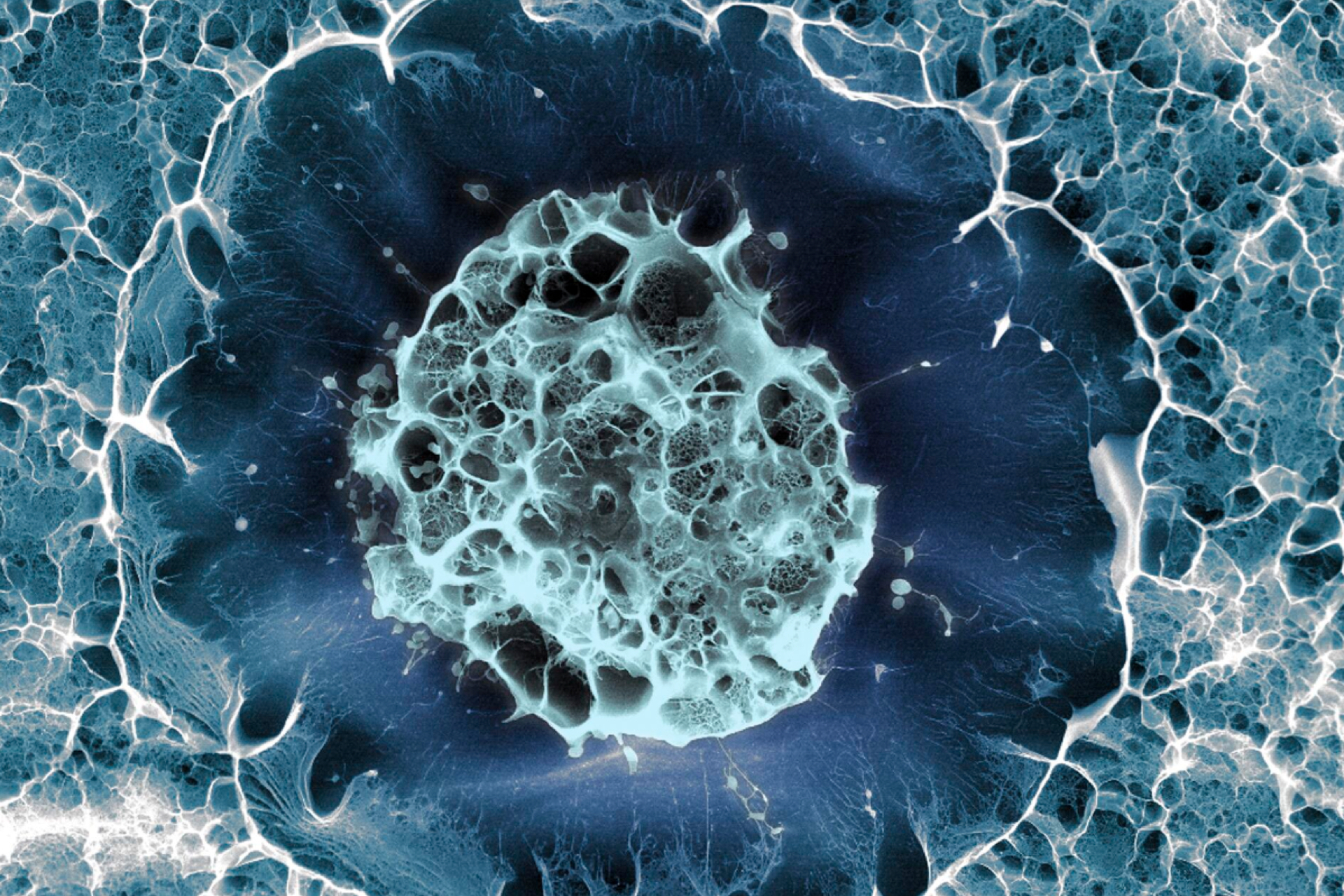
Human brain organoids have been kept in culture for more than five years, extending the period over which these models of human brain development have previously been maintained.
Human cerebral organoids, grown in a dish, allow researchers to study the development and maturation of cells of the cerebral cortex, which is difficult to study in vivo. However, previous studies of brain organoids have largely focused on early stages of development, with neuronal populations declining during longer periods in culture. A team of researchers from Harvard University in Cambridge, Massachusetts, has overcome some of the limitations and developed culture conditions that allowed organoids to be maintained for more than five years.
'Once we analysed the organoids, we realised that they didn't just survive for five years; they continued to change, develop and mature over time', said Dr Paola Arlotta, from the department of stem cell and regenerative biology at Harvard University and the senior author of the study published in Nature.
The team cultured 34 brain organoids made from human stem cells for more than five years and collected data from these organoids at various time points, integrating it with previously published data from 76 organoids collected between 15 days and six months, for a total of 110 organoids and 424,720 cells.
The researchers mapped transcriptional changes and epigenetic marks in organoids over time using single-cell RNA sequencing and DNA methylation. The team then compared these changes with stages of human brain development in vivo. They found that 15-day- to two-month-old organoids mapped predominantly to first-trimester fetal brains. Three- to six-month-old organoids mapped predominantly to second trimester fetal brains, while nine-month- to five-year-old organoids progressively shifted towards late prenatal and postnatal ages.
The team then investigated whether cells from older (nine- to twelve-month-old) and younger (fifteen-day-old) organoids would differ in their developmental responses when placed in the same environment. When neural progenitors from nine- to 12-month-old and 15-day-old organoids were combined, the older cells generated later-stage neurons, while the younger cells produced earlier-stage neurons. The older progenitors skipped developmental stages that they had already undergone, indicating that they retain a memory of their developmental age.
The researchers found that the organoids also underwent changes in DNA methylation that correlated with the time spent in culture. Epigenetic clocks predicted increasing age in organoids between three months and five years in culture, with the patterns paralleling aspects of epigenetic ageing in the human brain.
'If we can bank cells that retain their developmental age rather than having to recreate it every time, that could fundamentally change how we use organoids to study disorders that emerge later in brain development,' said Dr Maria Di Biase, a neuroscientist at the University of Melbourne, Australia, who was not involved in the study.
This study demonstrates that human brain organoids can continue to mature over several years in culture and retain molecular features associated with developmental age. The findings provide a model for investigating aspects of postnatal human brain development that are difficult to study in vivo.
Sources and References
-
Lab-grown brain 'organoids' set longevity record
-
Human brain organoids record the passage of time over multiple years
-
Five-year-old brain organoids can sense the passing of time
-
Human organoids that mimic brain development grown for years in lab
-
A 'renaissance for biomedicine': human brain organoids model development for five years
Related Articles


Human brain develops from two distinct groups of cells
The origins of the human brain can be traced back to two distinct groups of cells in the developing embryo...
Human brain tissue grows and connects inside engineered mice
Human organoids transplanted into mouse brains can grow and form connections with the surrounding nervous system...
Human organoids suggest that 'irreversible' nerve damage might be reversed
A developmental mechanism that restricts nerve regeneration has been identified using neural organoids...
Brain organoids could guide treatment of Alzheimer's disease
Brain organoids, and the tiny particles they secrete, may help to stage early Alzheimer's disease and evaluate drug response...
Book Review: Disembodied Brains – Understanding our intuitions on neuro-chimaeras and human brain organoids
Professor John Evans explores public and expert views on human brain organoids and neural chimaeras. He highlights the tension between scientific promise and public unease, providing an essential guide for anyone working with these emerging technologies...
Event Review: HDBI Ethics Seminar – Ethics of human brain organoids and human-animal chimaeras
Professor John Evans gives an insightful talk about the US public's opinion on the use of human brain organoids and human-animal chimaeras in research...
Whole-brain organoid mimics brain of 40-day-old fetus
Organoids comprising brain and blood vessel cells have been generated from human pluripotent stem cells, yielding a composition of different cell types similar to that of a 40-day-old fetus...
Organoids show head injuries may reactivate dormant virus and trigger Alzheimer's
Repeated head injuries, such as concussions, may increase the risk of Alzheimer's disease and dementia by reactivating the herpes simplex virus in the brain...
Robot controlled by human brain cells
A human brain organoid grown on a chip has been shown to control a robot that can be instructed to perform basic tasks...