

Organoids comprising brain and blood vessel cells have been generated from human pluripotent stem cells, yielding a composition of different cell types similar to that of a 40-day-old fetus.
A new type of brain organoid, which accurately mimics the interaction between different types of neural cells and basic versions of blood vessels in the brain, has been developed by researchers at Johns Hopkins University, Baltimore, Maryland. The group separately generated cerebral, mid/hindbrain and endothelial (blood vessel) organoids from human induced pluripotent stem cells, and then combined the different types of organoids using special sticky proteins.
'Most brain organoids that you see in papers are one brain region, like the cortex or the hindbrain or midbrain. We've grown a rudimentary whole-brain organoid; we call it the multi-region brain organoid (MRBO),' said Dr Annie Kathuria, lead author of the study published in Advanced Science.
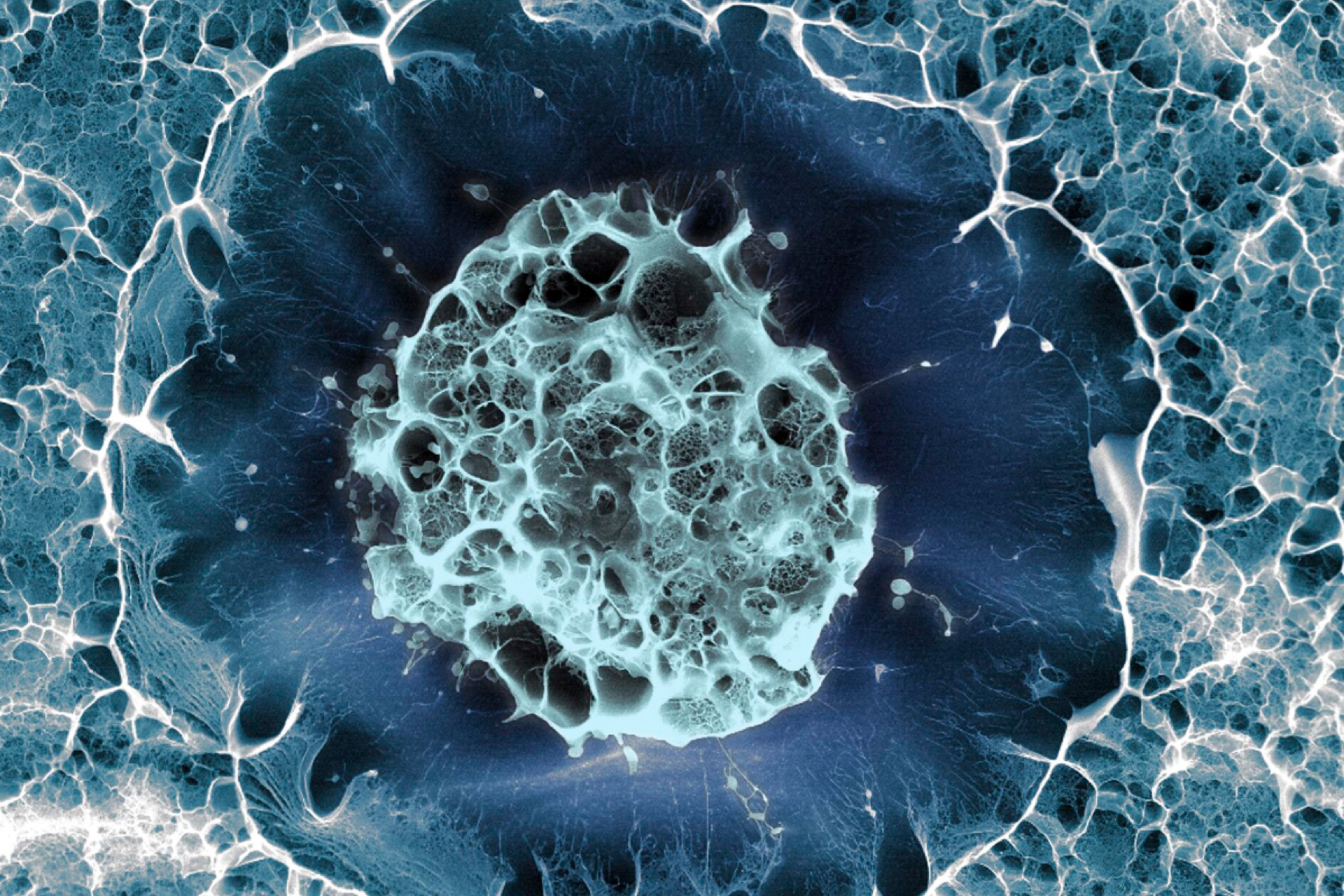
Organoids are small, three-dimensional replicas of organs, usually grown from pluripotent stem cells. MRBOs contain cerebral, midbrain, hindbrain and blood vessel cell types, which could allow study of the interaction between the blood vessels and neural cells in the brain. The researchers emphasise that MRBOs are not conscious and are considerably smaller than a human brain, although they did show some electrical activity and the formation of a rudimentary blood-brain barrier.
'Diseases such as schizophrenia, autism, and Alzheimer's affect the whole brain, not just one part of the brain. If you can understand what goes wrong early in development, we may be able to find new targets for drug screening,' said Dr Kathuria.
Neurological conditions affect more than one billion people worldwide and are difficult to study as they often involve multiple different regions and cell types within the brain. For example, schizophrenia and some types of autism are thought to involve the brain's vascular system as well as neural cells. As the MRBOs developed in this study include vascular cells, they could provide the opportunity to study and better understand these conditions.
'We can test new drugs or treatments on the organoids and determine whether they're actually having an impact on the organoids' Dr Kathuria added.
She and her colleagues hope that MRBOs could help to reduce the 96 percent failure rate for neuropsychiatric drugs in Phase I clinical trials as they provide a complex human-specific model, rather than the animal or simple human cell models currently used. There is also potential for patient-specific organoids to be developed, which could be used to determine the most effective treatment for each patient.
Sources and References
-
Johns Hopkins scientists grow novel 'whole-brain' organoid
-
Multi-region brain organoids integrating cerebral, mid-hindbrain, and endothelial systems
-
Lab-grown mini-brain with blood vessels could help slash 90 percent neurodrug failure rate
-
New human 'mini-brains' combine cells from the whole brain – even the blood vessels
Related Articles

Salivary gland organoids developed from human pluripotent stem cells
Human salivary gland organoids derived from pluripotent stem cells have been transplanted into mice....
Human brain tissue grows and connects inside engineered mice
Human organoids transplanted into mouse brains can grow and form connections with the surrounding nervous system...
What are the morally relevant features of stem-cell-based embryo models?
Dr Naomi Moris and an international group of colleagues propose three broad categories of ethical value and five categories of morally relevant biological features that can inform oversight of research involving human stem-cell-based embryo models...

Human brain organoids kept for more than five years in a dish
Human brain organoids have been kept in culture for more than five years, extending the period over which these models of human brain development have previously been maintained...
Event Review: HDBI Ethics Seminar – Ethics of human brain organoids and human-animal chimaeras
Professor John Evans gives an insightful talk about the US public's opinion on the use of human brain organoids and human-animal chimaeras in research...
Human brain development triggered by two key signals
Molecular signals that give identity to cells in the early developing brain have been identified...
Organoids show head injuries may reactivate dormant virus and trigger Alzheimer's
Repeated head injuries, such as concussions, may increase the risk of Alzheimer's disease and dementia by reactivating the herpes simplex virus in the brain...


Most comprehensive map of human brain development created
A map of DNA alterations in two regions of the developing human brain has been created...
Brain organoids created from human fetal tissue
Brain organoids developed from fetal tissue offer a new way to model brain diseases and aid in drug testing....
Brain organoids reveal genetic mutations affect emergence of neurons in people with autism
Mutations in three autism-associated genes have been shown to affect the pace that certain types of neurons emerge in the developing brain...