


Over the past decades, advances in paediatric oncology have transformed childhood cancer from a largely fatal disease into one that is now curable for many patients. But as researchers working in survivorship care, we see the second half of that story every day.
The majority of childhood cancer survivors go on to experience late complications associated with their cancer therapy throughout adolescence and adult life. Among these long-term sequelae, treatment-induced infertility is one of the most profound, leaving young survivors with few options when they later wish to start a family.
For adult men facing gonadotoxic therapies, preserving fertility can be achieved through a relatively straightforward procedure, as sperm samples can be collected and frozen before treatment begins. Prepubertal boys do not have that option, because their testes do not yet produce mature sperm. Today, many medical centres worldwide offer these boys the experimental cryopreservation of immature testicular tissue. However, this approach faces an important challenge: for logistical or medical reasons, some biopsies are taken after therapy has already started.
When we examined testicular tissues from two six-year-old cancer patients, which had been banked and analysed by the NORDFERTIL preservation consortium, the biological impact of that delay was evident. Their testicular tissue had been almost completely stripped of germ cells. Without a functional pool of spermatogonial stem cells (SSCs) – the essential cells that ensure continuous sperm production – standard fertility restoration methods simply cannot work.
In a recent study, we set out to test a potential workaround. If the germ cell pool is gone, can we take the supporting somatic cells left behind in those same treated biopsies, and use them to rebuild a patient's germline from scratch?
From tiny fractions of these banked tissues, we isolated the primary testicular supporting cells – such as Sertoli and interstitial cells – and expanded them in the lab. Using a non-genome-integrating mRNA protocol under feeder-free conditions, we successfully reprogrammed these supporting cells into human induced pluripotent stem cells (hiPSCs), as illustrated below.
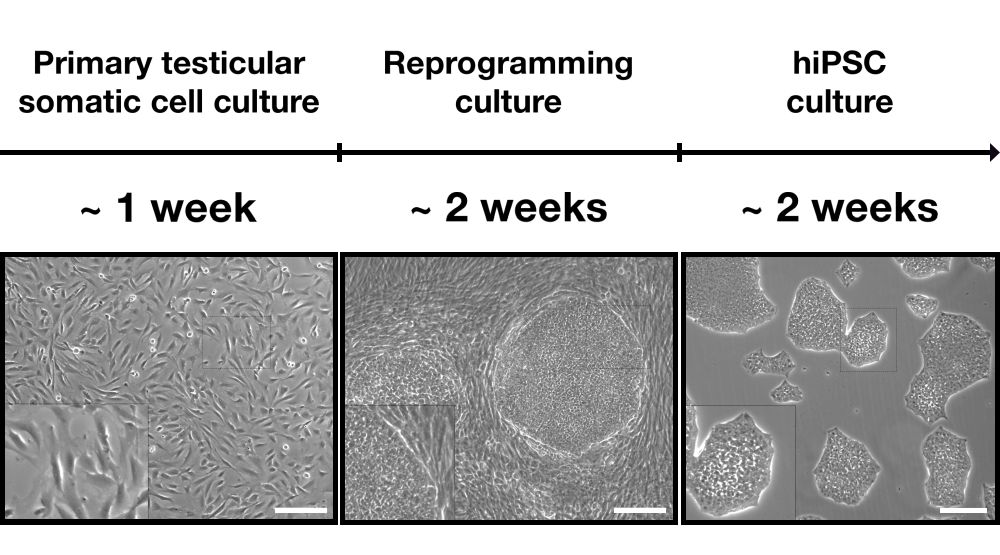
Left panel: Phase-contrast image of primary testicular somatic cells isolated and expanded from cryopreserved prepubertal testicular tissue.
Middle panel: Emerging hiPSC colony during mRNA-based reprogramming.
Right panel: Expanded patient-derived hiPSC line exhibiting characteristic pluripotent morphology with tightly packed cells and well-defined colony borders.
Scale bars = 200 μm.
When we directed these patient-derived hiPSCs towards the germline fate using two distinct differentiation protocols, they generated human primordial germ cell-like cells (hPGCLCs) – the in vitro equivalent of early embryonic germ cells – with efficiencies of around 20 percent, as illustrated below.
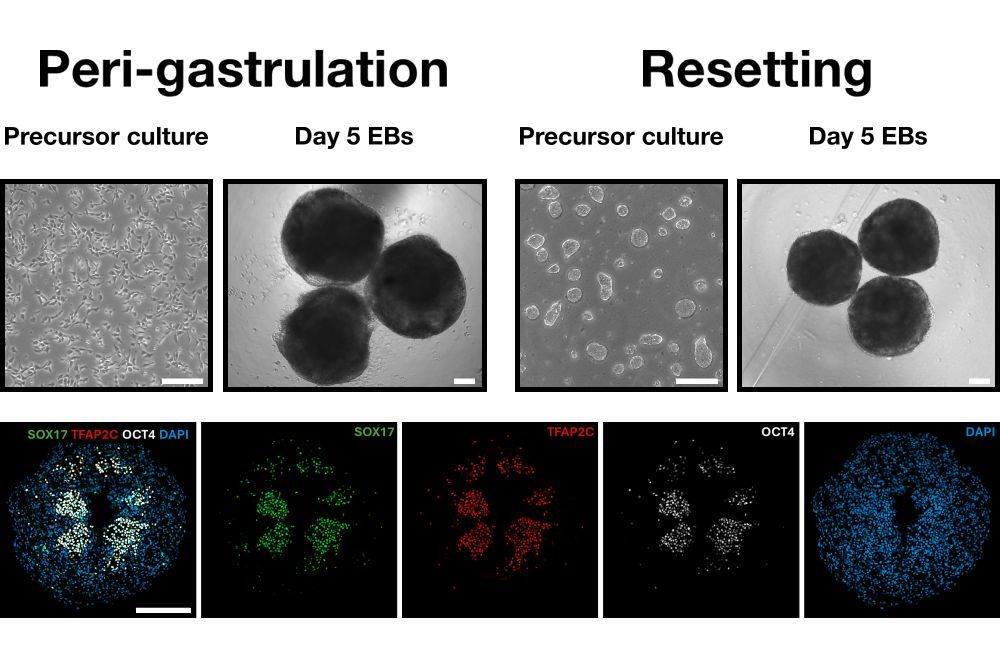
Top panels: Phase-contrast images of precursor cultures – peri-gastrulation (left) and resetting precursors (right) – alongside their corresponding embryoid bodies (EBs) following five days of hPGCLC specification.
Bottom panels: Immunofluorescence staining of a representative day five EB section. The merged image (far left) demonstrates localised co-expression of key early human germline markers: SOX17 (green), TFAP2C (red), and OCT4 (white), with nuclei counterstained by DAPI (blue). Individual fluorescent channels are displayed to the right.
Scale bars = 200 μm.
However, we must be realistic about the current clinical potential of the in vitro-derived germ cells that we generated from these two patients' hiPSCs. Human PGCLCs represent a very early embryonic stage of gametogenesis. They are not mature sperm, nor are they functional SSCs capable of restarting spermatogenesis after transplantation into a patient. Therefore, bridging the gap between early hPGCLCs and functional SSCs remains a bottleneck in human regenerative reproduction.
Most attempts to mature hPGCLCs rely on co-cultures with mouse embryonic tissues or other non-human animal-derived reagents. Aligned with this approach, an important proof-of-concept investigation demonstrated recently that hPGCLCs can be matured to a SSC state, following aggregation with mouse fetal testicular somatic cells and transplantation under the kidney capsule of immunodeficient mice.
Therefore, the translation of this work into clinical application will initially require fully defined, xeno-free culture systems that faithfully model the maturation of hPGCLCs into SSCs, backed by rigorous genetic and epigenetic profiling to guarantee that only fully matured cells are transplanted into a patient. Just as importantly, these laboratory advances do not exist in a vacuum. Developing in vitro gametogenesis forces us to confront difficult but necessary legal and ethical questions around the use of these cells and related regulation, long before any cell therapy reaches a clinical trial.
Even if clinical cell therapies are years down the road, patient-specific hiPSCs – such as the ones generated in our work – offer immediate scientific value. Because each line preserves the unique genetic background of the patient from whom it was derived, it gives us the opportunity to study the impact of cancer therapy on regenerative capability at an individual patient level.
Regarding the starting biological material used to generate patient-specific hiPSCs, we used already available biobanked testicular samples, which are invasive to obtain and not suited for every cancer patient. From a clinical practice perspective, a small skin punch biopsy or blood sample taken at diagnosis, before any gonadotoxic therapy begins, could provide an unexposed and less invasive source of somatic cells. These banked skin or blood cells could later be reprogrammed into hiPSCs as needed in adulthood, offering a reliable backup for future stem cell-based therapies using cells that were never exposed to cancer treatment.
Our research is ultimately about giving childhood cancer survivors more choices later in life to restore their fertility. We believe that in the future, it may be possible to expand the options available to these patients, so that survival does not necessarily come at the cost of the possibility of biological parenthood.
Related Articles

FILM: Male Infertility – Today's Insights, Tomorrow's Treatments
This film documents a PET event featuring researchers and practitioners at the forefront of tackling male infertility, discussing the latest insights and pioneering research that could transform treatment in future...

In vitro gametogenesis: The case for an anticipatory approach
Lead author of the Regulatory Horizons Council's report on in vitro gametogenesis, Dr Andy Greenfield, argues that the UK should begin preparing now for emerging reproductive technologies, taking an anticipatory approach to regulation...
PET Podcast: Male Infertility – Today's Insights, Tomorrow's Treatments
Bringing you PET events as a podcast. The 48th episode of the PET podcast features researchers and practitioners at the forefront of tackling male infertility – Kevin McEleny, Professor Joris Veltman, Professor Rod Mitchell and Professor Sarah Martins da Silva...

Evidence of sperm production following testicular tissue transplant
Testicular tissue preserved before puberty shows signs of being capable to create sperm after being grafted back into the same patient in adulthood, a proof-of-concept study reports...
Male Infertility: Today's Insights, Tomorrow's Treatments
The most recent PET event took place in Edinburgh and brought together researchers, clinicians and members of the public to examine advances in understanding and treating male infertility...

Man receives transplant of his frozen prepubescent sperm-producing stem cells
A 26-year-old male cancer survivor received a transplant of his frozen prepubescent sperm-producing stem cells...