

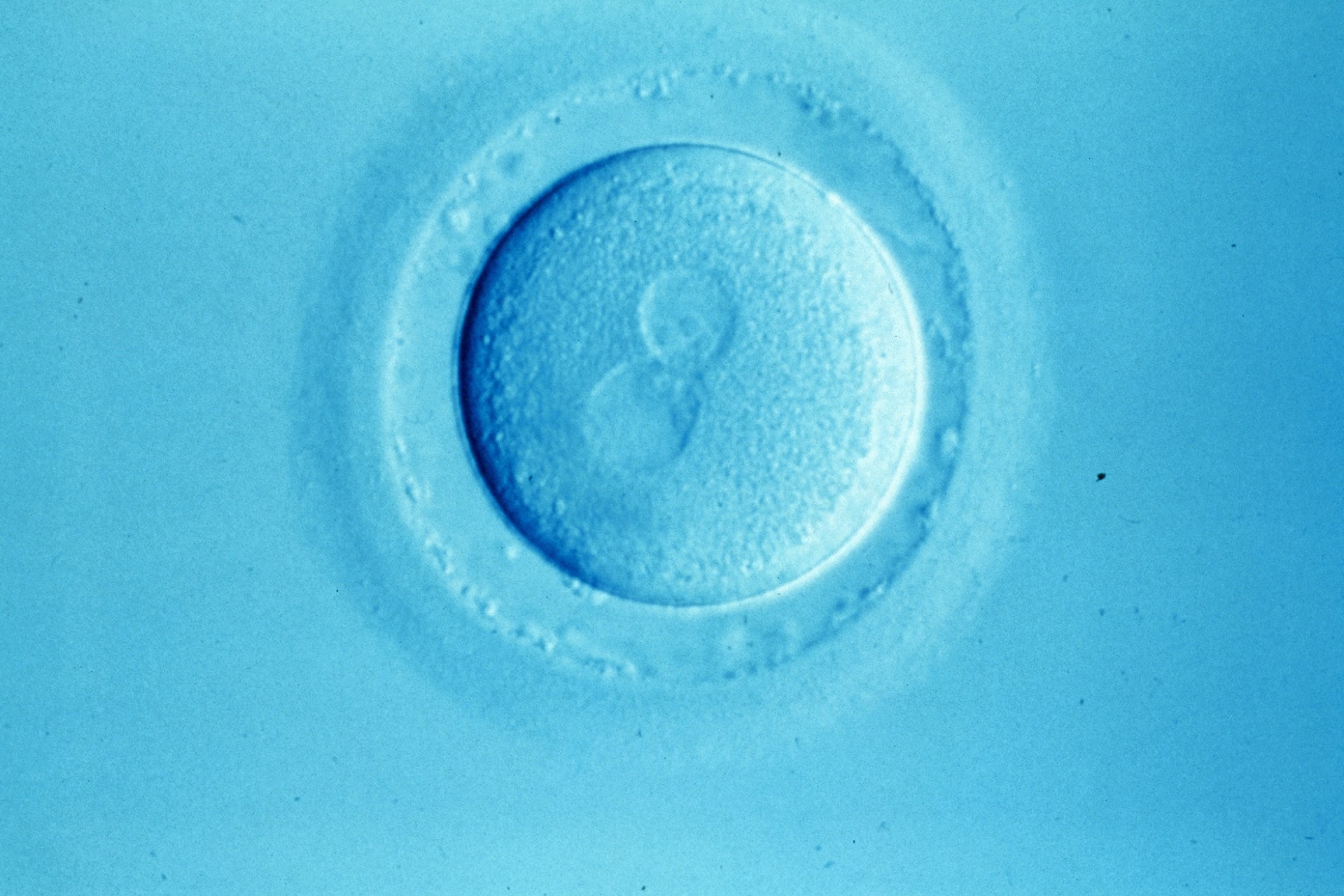
Imagine the following. You are a young man, and together with your partner, you sit in the doctor's office when the devastating news is brought to you. You are infertile. Period. No sperm cells have been found either in your ejaculate or in the surgical biopsy they did last week. None of the fertility treatments available are an option, since they all require mature sperm. In the distance, you hear the doctor mentioning alternatives. Sperm donation, adoption.... Your partner nods in understanding, but you just cannot process it. How come, with all the medical advancements, there is nothing to do about it? Your dream of raising a child of your own shatters into a thousand pieces.
Imagine that you start browsing the internet, looking for a treatment that might give you back the chance of conceiving a child of your own. You stumble upon a website where you see a young man holding a newborn child. He cradles the child with a thankful and loving smile, seemingly taking in that typical newborn scent. The text says: 'From infertility to parenthood. Overcoming male infertility: Our pioneering in vitro spermatogenesis offers new hope for starting a family'. Your heart makes a leap. You could be that guy in the picture!
But can you? Is the creation of sperm cells in the lab already possible for clinical use?
Paterna BioSciences is a startup company that publicly announced its claim to have achieved human in vitro spermatogenesis in April this year. And first of all, we cannot agree more with their motivation: infertility is a pressing matter, and male factors are estimated to contribute to around half of all cases of infertility. The news of not being able to conceive is heartbreaking. While research in infertility has mostly focused on female infertility, research on male infertility is urgently needed.
In vitro spermatogenesis, the formation of human sperm from stem cells in the lab, would be both scientifically and societally groundbreaking. Several laboratories in the world are pursuing this goal, including our own as part of the HipGametes consortium. Although progress has been reported in research using human cells, generating fully functional human sperm in vitro remains a major scientific challenge. To our knowledge, no peer-reviewed publication has demonstrated the successful production of human sperm in vitro that is ready for clinical use.
Before diving deeper, let's cover the basics. In the human body, sperm is made in the testes, where spermatogonial stem cells differentiate into sperm. The steps involve both mitosis (normal cell division) and meiosis (reproductive cell division, leading to halving of the DNA content). It is an extremely balanced and intricate process involving several cell types, timely hormonal cues and several cellular checkpoints that ensure the safety and integrity of the genome.
Reproductive biologists like ourselves still do not understand the process from A to Z. In this, we are largely hampered by the absence of a good research model to study spermatogenesis. In vitro spermatogenesis would provide such a research model to study both how spermatogenesis works and the reasons for male infertility better, ultimately helping to improve reproductive medicine to help young men like you just imagined yourself to be.
Perhaps the most critical process during sperm formation is meiosis, which ensures that sperm carry a single set of chromosomes into the next generation. During meiosis, the genome is first replicated and then divided through two successive cell divisions to produce four future sperm cells. Moreover, during these meiotic divisions, the genome is further shuffled by DNA breaks that are repaired via meiotic recombination.
Luckily for us, proper divisions and repair of our genome during meiosis are thoroughly checked by meiotic checkpoints. To prevent genomic aberrations in our offspring, these checkpoints eliminate cells when meiotic errors are detected. Although in vitro meiosis and sperm production have been achieved in mice, these checkpoints appear not to work properly in vitro. It seems obvious to us that more research in in vitro meiosis is necessary before making claims about the potential clinical application of lab-generated sperm.
Other processes, like point mutations that can occur during stem cell culture, and in vitro sperm maturation, will need to be investigated thoroughly. All of this is needed not only to gain insights into the potential effectiveness of in vitro spermatogenesis, but also its safety.
At present, Paterna BioSciences has not made publicly available peer-reviewed research demonstrating the successful production of human sperm through its approach. The publications that the Paterna BioSciences website refers to link to scientific papers related to male (in)fertility carried out by researchers at academic institutes or universities, rather than presenting evidence of the company's own achievement. Importantly, none of these publications presents successful human in vitro spermatogenesis.
At the top of its website, Paterna BioSciences makes the claim: 'We achieved the world's first in vitro spermatogenesis'. However, this claim links to an article in Wired. Wired is not a scientific journal, and its articles are not peer-reviewed. Furthermore, the article does not provide scientific evidence to support Paterna BioSciences' claim. In this interview, little information is provided about the protocol they developed or the quality of the sperm produced, but it does mention an estimated treatment cost of $5000-$12,000.
Of course, it would be great if Paterna BioSciences had achieved spermatogenesis from a patient's own stem cells in the lab, with the resulting sperm being safe to use in treatments and for the children conceived using them. However, at its current stage, the public evidence appears insufficient to support the suggestions that this is a treatment on the horizon. This risks creating unrealistic expectations among vulnerable patients. As scientists in this field, we share their vision of making in vitro spermatogenesis a reality. Still, the goal should be to chase that ambition while communicating honestly about what patients can, and cannot, expect.
Let's return to our young man, sitting at his laptop. Encouraged by the news, he searches for more information. Could this treatment really be an option for him? Disappointment sets in the moment he realises that what he had dared to imagine, a chance to become a biological father, is but a mere distant prospect, not a treatment he can actually access. In vitro spermatogenesis is not yet available to him; not at this moment in time. What briefly felt like a way forward becomes another door closed, leaving him to face not only his infertility, but also the pain of hope raised and then taken away.
Related Articles


Giving more choices to survivors of childhood cancer
Researchers working in childhood cancer survivorship explain how patient-derived stem cells could one day expand fertility restoration options, for boys whose cancer treatment has damaged their developing testes…

FILM: Male Infertility – Today's Insights, Tomorrow's Treatments
This film documents a PET event featuring researchers and practitioners at the forefront of tackling male infertility, discussing the latest insights and pioneering research that could transform treatment in future...

In vitro gametogenesis: The case for an anticipatory approach
Lead author of the Regulatory Horizons Council's report on in vitro gametogenesis, Dr Andy Greenfield, argues that the UK should begin preparing now for emerging reproductive technologies, taking an anticipatory approach to regulation...
PET Podcast: Male Infertility – Today's Insights, Tomorrow's Treatments
Bringing you PET events as a podcast. The 48th episode of the PET podcast features researchers and practitioners at the forefront of tackling male infertility – Kevin McEleny, Professor Joris Veltman, Professor Rod Mitchell and Professor Sarah Martins da Silva...
Evidence of sperm production following testicular tissue transplant
Testicular tissue preserved before puberty shows signs of being capable to create sperm after being grafted back into the same patient in adulthood, a proof-of-concept study reports...
Male Infertility: Today's Insights, Tomorrow's Treatments
The most recent PET event took place in Edinburgh and brought together researchers, clinicians and members of the public to examine advances in understanding and treating male infertility...
HFEA recommends law review in light of lab-made eggs and sperm
New possibilities for culturing human eggs and sperm in the laboratory have led the Human Fertilisation and Embryology Authority to consider whether the law in this area should be reviewed...