


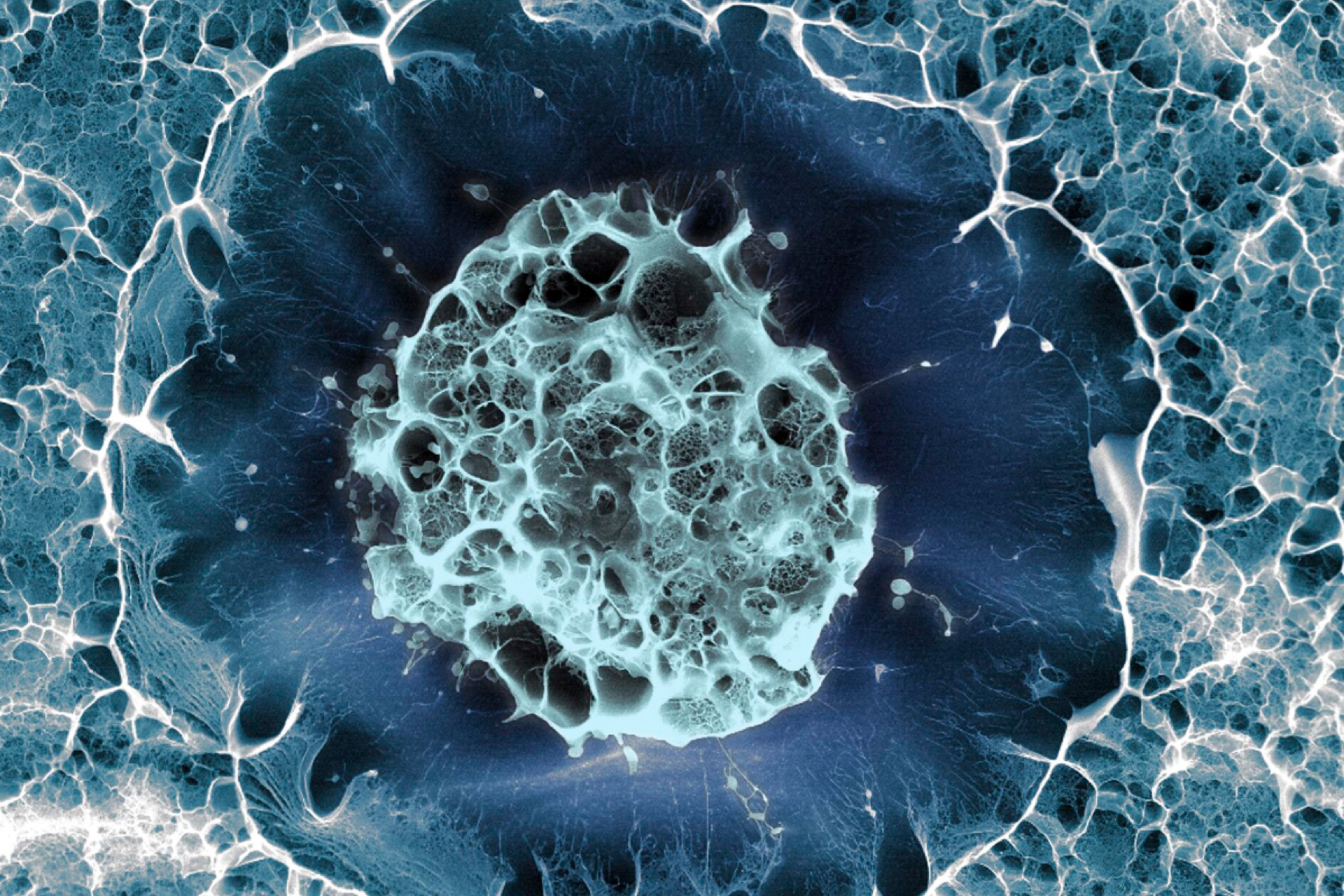
A programmable stem cell model, with the ability to mimic early stages of mammalian development, has been created using an engineering biology technique.
Researchers from the University of California, Santa Cruz, aimed to create a reproducible and customisable mouse embryo model to complement and improve existing approaches. Stem-cell-based embryo models (SCBEMs) are cell aggregates that resemble embryos in the early stages of development, allowing scientists to study how cells interact between them (see BioNews 1219, 1204, 1124, 1091, 1088 and 1020). Three types of cells are needed to model the early mouse embryo in its entirety – cells that will form the embryo itself, cells that will generate the placenta, and cells that will give rise to the yolk sac.
'We as scientists are interested in recreating and repurposing natural phenomena, such as formation of an embryo, in the dish to enable studies that are otherwise challenging to do with natural systems', said Dr Ali Shariati, principal investigator and senior author of the paper published in Cell Stem Cell.
In order to create SCBEMs, scientists need to generate the required cell types prior to or during cell aggregation. Other methods depend on media optimisation, require overexpressing genes or use cell lines derived from embryos.
This particular study used CRISPR activation, an epigenome editing technique that does not alter DNA sequences but rather enhances gene expression. By activating factors known for their role in development, the researchers were able to generate the three cell types they needed from embryonic stem cells. These cells were able to form an aggregate that, after a few days, resembled a day 5-6 mouse embryo.
'These cells co-develop together, just like they would in an actual embryo, and establish that history of being neighbours,' Dr Shariati said. 'We do not change their genome or expose them to specific signalling molecules, but rather activate the existing genes'.
Epigenetic changes have been known to occur during early development, affecting factors involved in determining the identity of cell types. However, epigenetics had not been explored in this way in SCBEMs before now. The new study shows that editing epigenomes is sufficient to allow stem cells to self-organise into reproducible SCBEMs.
Beyond just making a model that mimics an embryo, this editing technique allowed researchers to understand the role of other factors during this crucial stage of development. The system is also programmable, meaning that it gives scientists the ability to control the expression of certain genes in a specific cell type only. The precision of the approach could show how certain genes affect a lineage, while also affecting neighbouring cells.
'We want to know how cells organise themselves into an embryo-like model, and what could go wrong when there are pathological conditions that prevent an embryo from successfully developing,' explained Dr Shariati, whose team is interested in using this technique in other mammalian species.
This embryo model offers the potential to test a large number of genes, and identify whether and when expression of these genes is crucial for successful development.
Read the Code of Practice for the Generation and Use of Human Stem-Cell-Based Embryo Models, published jointly by Cambridge Reproduction and PET.
Sources and References
-
Scientists program stem cells to mimic first days of embryonic development
-
Self-organisation of mouse embryonic stem cells into reproducible pre-gastrulation embryo models via CRISPRa programming
-
Epigenetic editing of mouse stem cells generates embryoids for developmental research
-
Scientists harness cellular programming to simulate the earliest stages of embryonic development
Related Articles

Mouse stem-cell-based embryo models mimic natural blastocysts
Mouse stem cells have been used to create an embryo model that mimics the stage where an embryo implants into the uterus...
Development paused in human blastoids
Stem cell models of early preimplantation human embryos have been shown to retain the capacity to pause development, using a mechanism observed in other mammals...
First dedicated guidance for embryo model research published by experts
A code of practice to govern the use of stem-cell-based embryo models in research has been developed by an interdisciplinary group of experts, drawn from institutions across the UK...
Stem-cell-based embryo models used to study human twinning
Embryo models generated from human stem cells have provided insights into how identical twins develop...
Embryo model resembles the early stages of the complete human central nervous system
Human pluripotent stem cells have been used to create a complete model of the human central nervous system and mirror its early stages of development in vitro...

Blood cell development seen in human embryo model
A human embryo model created from adult stem cells shows the production of blood cells during early development...